It’s a simple question: Why don’t Ukrainians have a wide range of fresh vegetables and fruits all year round at decent prices?
The answer is connected not only to the weather and underdeveloped agriculture, but also with a challenging set of logistical problems – including poor roads, lack of warehouses and an unpredictable customs service.
All of these factors keep the Ukrainian market for fresh vegetables and fruits under-supplied.
Warehouses for special purposes – such as storing fresh, chilled and frozen goods – are especially in short supply.
According to Colliers International, a global real estate consultancy, Ukraine has 200,000 square meters of warehouses capable of cold storage. Most are near Kyiv.
To satisfy Ukraine’s current demands, the country would need to have 600-700,000 square meters.”
– Oleg Kalensky, a management consultant in logistics and retail.
At the same time, from available Colliers International reports, in 2008 countries like Russia had 18 million square meters of cold-storage warehouses, Germany had 16 million, and France nearly 10 million.
“To satisfy Ukraine’s current demands, the country would need to have 600-700,000 square meters,” says Oleg Kalensky, a management consultant in logistics and retail.
Among the most recent openings of cold warehouses, Raben Group – an international logistics operator – opened in October a 4,200 square meter logistics center and support network for fresh products in the Brovary area near Kyiv.
“Next year we plan to double fresh products storage because the market is largely undersupplied,” said Dmytro Yatsunskiy, a Raben Group spokesperson.
Logistics experts say fresh vegetables and fruits are difficult to store safely for long. Freezing the produce can make them inedible. Apart from temperature conditions, fresh products need to be transported in containers with air vents.
“The air vents are kept open during transit, not for temperature reasons, but for the fact that a constant flow of fresh air will allow the products to retain freshness,” said Emilio Riccio, professor of logistics and chairman at Society of International Logistics and Operations.
The deficiency may well be more in the matter of experienced or trained personnel rather than warehouse design.”– Emilio Riccio, professor of logistics and chairman at Society of International Logistics and Operations.
“The deficiency may well be more in the matter of experienced or trained personnel rather than warehouse design.”
Riccio said that unreliable customs procedures can also hamper successful imports.
The warehouse segment was hit hard by the real estate downturn in 2008-2009.
“Two things occurred simultaneously: the demand fell to almost zero and the supply grew by 80 percent of already existing stock,” said Arkadiy Vershebenyuk, director of the industrial agency department at Colliers International Ukraine.
“That is why, for the moment, the supply of [regular temperature] warehouses is still higher than the demand,” Vershebenyuk said.
“As for special warehouses with low temperature or specific climate (i.e. for fresh products, dairy and pharmaceuticals) – the demand/supply gap in not so large and there is room for new projects.”
Vershebenyuk says the demand for cold-storage warehouses is largely driven by the development of retail.
Within the next two or three years, development may be also driven by the growth of big transportation hubs in regions, such as Dnipropetrovsk for eastern Ukraine, Odessa because of its Black Sea port and Lviv and Ternopil in the western region. Still, market insiders do not expect the situation to change in the near future.
Consultant Kalensky said other obstacles are the poor state of roads and difficulties in obtaining permission to build warehouses.
The cost of constructing refrigerated warehouses is also higher than regular ambient ones.
If you want to have fresh products on shelves, you need to have them shipped directly into outlets (by milk-runs) in 12-24 hours, which increases the transportation costs by 40-50 percent or more.”– Oleg Kalensky, a management consultant in logistics and retail.
All of this means a poor return on investments and retards foreign interest in developing modern storage places in Ukraine.
So that is why Ukrainians have less vegetables and fruit to choose from than desirable outside of the local growing season.
“If you want to have fresh products on shelves, you need to have them shipped directly into outlets (by milk-runs) in 12-24 hours, which increases the transportation costs by 40-50 percent or more than a regular scheduled delivery within a distribution model,” Kalensky said.
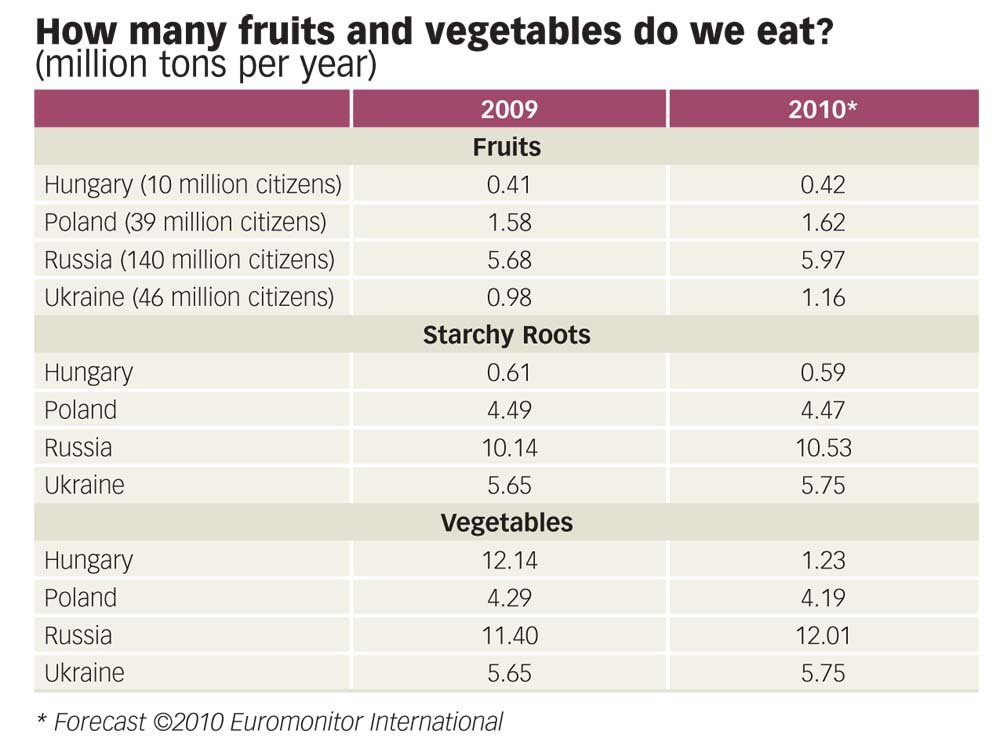
Euromonitor, an international market research consultancy, said Ukraine consumed 983,700 tons of fruits in 2009, 5.6 million tons of vegetables and 5.6 million tons of starchy roots.
“In Ukraine the share of temperature-sensitive products in the consumer basket grows year on year,” Kalensky said. “Still it is lower than the European average of 25 percent.”
Kyiv Post staff writer Olga Gnativ can be reached at [email protected].