Ukraine’s privatization program is well behind schedule and as murky as ever, even while the government continues to dig itself deeper and deeper into debt.
While the country’s citizens will have to shoulder the nation’s debt burdens, the few state assets that have reached the auction block have been sold at bargain basement prices to Russian and Ukrainian tycoons.
So far, Ukraine has received less than $53 million from privatization, or 7 percent of its goal for 2010, the State Property Fund reported last month.
The government had projected privatization revenues of more than $820 million as part of this year’s state budget.
And, as recently as June, Deputy Prime Minister Sergiy Tigipko told an investor conference in Moscow that President Viktor Yanukovych plans to cut state ownership in the economy to as low as 20 percent from the current 37 percent within five years.
This feat, Tigipko said, could be accomplished by selling off thermoelectric generators and electricity distribution utilities in addition to Ukrtelecom, the country’s fixed-line telephone monopoly, and the Odesa Portside Plant, a strategic chemical maker.
But now the sales of these assets – including the billion-dollar Ukrtelecom and Odessa plant – are expected to be put off yet again, until next year at the earliest.

September 2009, Tymoshenko orders cancellation of sale of prized state chemical maker, Odesa Portside Plant, following its televised auction after accusing Ukrainian tycoons of colluding to keep the sales price low – $600 million instead of the $1 billion that many expected it to fetch.
A month after Tigipko talked about speeding up the process, privatization chief Oleksandr Ryabchenko described next year as a more likely auction date for the Ukrtelecom, which is estimated to be worth at least $1 billion.
As for ammonia producer Odesa Portside Plant, former Prime Minister Yulia Tymoshenko cancelled its highly anticipated sale last year for $600 million, claiming that Ukrainian tycoons and a Russian company taking part in the bidding had conspired to fix the price, which she had expected to reach $1 billion.
And this was by no means an isolated example of highly suspicious state sales.
A 75 percent stake in state locomotive maker Luhanskteplovoz was sold to a Russian buyer in 2007 for half the company’s market value: $52 million against a market capitalization of the entire asset of $130 million.
Again, it was Tymoshenko who pushed for the cancellation of the auction, which was repeated this year under Prime Minister Mykola Azarov, fetching several million dollars less than three years ago.
Since then, the government has limited itself to selling off its minority stakes of 25 percent in a couple of oblenergos, or regional energy distributors, whose majority oligarch owners allegedly colluded in keeping the sale price low.
In Kyiv, the privatization picture is even more dismal, with lucrative land plots having been sold off for a fraction of their worth under eccentric Mayor Leonid Chernovetsky.
The paperwork subsequently disappeared. More recently, 80 percent of Kyivmiskbud, Kyiv’s city-owned construction company once valued at $700 million, was opaquely transferred in August from municipal ownership to still unknown owners. On Sept. 1 the price of the deal was revealed as $14 million.
All of these tainted deals and auctions stand out in marked contrast to the sale of the nation’s largest steel mill, Kryvorizhstal, in 2005 for a record $4.8 billion to international steel giant Mittal (now ArcelorMittal).
As with Luhanskteplovoz and Odesa Portside Plant, Tymoshenko spearheaded the cancellation of an earlier state auction for the plant. That discredited and reversed sale fetched only $800 million from the nation’s leading billionaires, Rinat Akhmetov and Viktor Pinchuk.
According to Oleksandr Bondar, a former State Property Fund chief and currently the deputy head of parliament’s control commission for privatization, the foot-dragging under the Yanukovych administration means that the five-year trend of non-transparent auctions isn’t likely to change.
“The authorities are taking their time, figuring out who gets what,” Bondar said. “All this is being done behind the scenes.”
Not only are few state assets being put up for auction, but international buyers willing to pay a market price are hesitant to show any interest due to Ukraine’s shady privatization history, he said.
“When [former President Viktor] Yushchenko was in power, he held things up. Now it’s Yanukovych doing so. If he wanted to move privatization along, he could do so,” Bondar said.
In support of the government, however, some international analysts such as Timothy Ash, head of emerging markets research at the Royal Bank of Scotland in London, believe that now is not the time to be selling state assets.
And, according to Ash, the International Monetary Fund, which just approved a $15 billion loan agreement with the Azarov government to help it plug gaping budget holes, agrees.
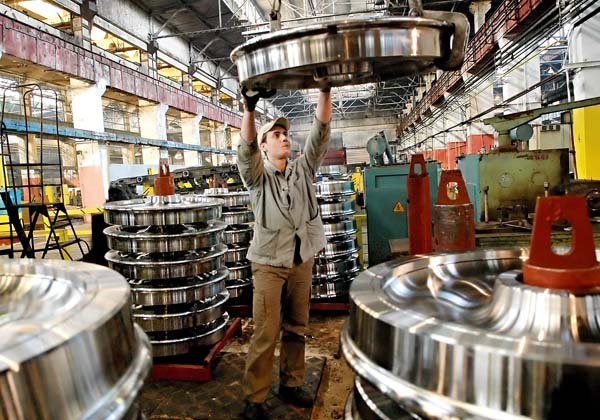
June 2010, the Mykola Azarov government sells a 76 percent stake in big locomotove maker Luhanskteplovoz to Russian Bryanskiy Zavod in an auction for $51.8 million, or almost $7 million less than the same buyer paid for the plant three years earlier. The 2007 sale had been cancelled by a court decision because the only two bidders were both part of Russian Transmashholding and the sales price was tens of millions of dollars less than the company’s market capitalization at the time.
“The fund agreed to the government’s decision to reduce the target for privatizations (cut by 70 percent) in 2010, and indeed seem pretty relaxed/realistic about likely receipts from state asset sales. They recognize that the global environment for such sales is likely to be muted, limiting the cash return and encouraging a delay in such sales,” he wrote in a research note.
In return for IMF money, though, the government agreed to cut public spending, raise gas prices for the population and increase the retirement age for pensioners – all measures that disproportionately fall on average citizens.
Figures from the Finance Ministry put Ukraine’s state debt already at $43 billion in June excluding the IMF loan). Revenues from privatization for the last 19 years, meanwhile, come to a paltry $47 billion.
But according to Martin Raiser, country director for the World Bank in Ukraine, Belarus and Moldova, comparing privatization receipts and state borrowing is like comparing apples and oranges.
He warned that a privatization program should be seen as a part of structural reforms rather than used to fill empty budget coffers.
“This is a one-off effort and thus the systemic budget problems aren’t resolved. The primary purpose behind privatization should be to find the right private owner for the asset, who would pay taxes and hire employees, while simultaneously stop draining budget funds in subsidies and other forms of support,” he said.
However, the authorities have hardly got a strong track record for finding the best owner, with many assets sold off on the cheap to well-connected buyers.
And the budget gap will have to be filled, one way or another.
“From the very beginning, privatization receipts were supposed to go toward social spending, until reforms boost economic development, but the authorities have kidnapped reforms as well as privatization,” former privatization chief Bondar said.
Only after the state cleans up the way it holds auctions will cash-paying buyers take an interest and the real value of Ukraine’s state assets become clear, according to Bondar.
“No one thought the government could get $4.8 billion for Kryvorizhstal either,” he said.
Kyiv Post staff writer John Marone can be reached at [email protected].