Ukrainian energy officials are waging a war with each other for control over the country’s lucrative but secretive electricity export business.
At stake are the reputations of Ukraine’s top energy officials and that of a prominent businessman who served in the government.
Fuel and Energy Minister Ivan Plachkov locked horns last week with Oleg Bugayov, the director of state electricity export monopoly Ukrinterenergo, with each man accusing the other of causing the state millions of dollars in losses from contracts with electricity buyers in Eastern Europe.
Bugayov told a March 6 press conference in Kyiv that Plachkov and his deputy, Yuriy Prodan, had tried to make him sign unprofitable contracts with new electricity buyers, which, among other things, would cost the state $50 million in penalties.
The Energy Ministry, Bugayov said, has been attempting to remove him illegally from office since last November, renewing its efforts earlier this month, when Ihor Drozdov, the head of the ministry’s financial department, was brought into Ukrinterenergo as president and accompanied by “people in camouflage uniforms.”
“I take this as a reprisal. They are doing a lot of harm, hurting the image of the country,” Bugayov told journalists.
No denials
Plachkov’s office doesn’t deny trying to get rid of Bugayov, accusing him in a March 7 statement of selling Ukrainian electricity too cheaply in Poland, Slovakia and Hungary. According to the ministry, Bugayov, who has been in charge of Ukrinterenergo since Feb. 2005, was obliged by contract to bring the state Hr 5.3 million (over $1 million) in net profits last year, but achieved only 10 percent of this figure.
All the while, the ministry said, Bugayov was made aware of other proposals from other Eastern European buyers who were willing to pay for Ukrainian electricity at a higher price.
The ministry also accuses Bugayov of everything from feigning sickness (in November 2005), to joining the little known parliamentary bloc Party of Environmental Salvation (which according to Ukrainian law prevents him from being fired until March 26 general elections) in order to stay in control of electricity exports.
So on Feb. 28, Drozdov was appointed president along with a new team of top managers in accordance with changes to the company charter passed a few days earlier.
Months earlier, when Bugayov was on sick leave, the ministry had started chipping away at the established system of Eastern European buyers. Under an acting director, Ukrinterenergo signed a contract with another Hungarian trader called Energy Capital. According to the ministry, the new contract increased the price of electricity by 30% and end-of-the-year revenues by $25 million.
But regardless of who is cutting the deals for Ukraine’s electricity exports, the way the deals are cut leaves anyone in charge of Ukrinterenergo vulnerable to charges of corruption.
Lilia Klochko, press secretary for the Ministry of Fuel and Energy, said information about the price for which Ukrinterenergo pays for electricity at home and what it sells for abroad is “confidential information and not subject to public divulgence.”
It’s Ukraine’s National Electricity Regulation Commission that sets the secretive price paid by Ukrinterenergo for Ukrainian electricity. Then the state monopolist resells it in countries on the western border – Hungary, Poland, Slovakia and Romania – for an equally undisclosed amount.
The average Wholesale Electricity Market Price in Ukraine in 2005 was 15 kopecks/kWh or 3 cents, said Yuriy Kubrushko, general director of IMEPOWER Consulting, a Kyiv-based energy sector consultancy.
This is the price paid for electricity by Ukraine’s oblenergos, or regional electricity suppliers.
“As far as I know, Ukrinterenergo buys electricity at a price a little bit lower than what is offered on the Wholesale electricity market (in Ukraine),” he added.
“But taking into account the difference in prices for electricity between Ukraine and Eastern Europe, this business has always been profitable.”
Losses?
However, a graph released by Ukrinterenergo shows that the state-owned company reported losses of Hr 6.3 million in 2004 and only Hr 500,000 in profits last year.
In 2004, Andriy Tkachenko headed Ukrinterenergo. He’d been appointed two years earlier, when Vitaly Hayduk served as energy minister. Bugayov was Tkachenko’s deputy.
An article published in late February on Ukrainian Web site Ukrainska Pravda linked Bugayov and Tkachenko with Hayduk, reportedly a co-owner of Donbas Industrial Union, one of Ukraine’s largest industrial groups. Citing informed sources, the same article also linked Hayduk with co-owners of firms in Hungary and Poland that buy Ukrinterenergo’s electricity.
Ukrinterenergo, founded in 1993, was in 2004 put under the control of the Energy Company of Ukraine, established to manage all the state’s other electricity assets. It was the Energy Company of Ukraine, managed by the energy ministry, that recently changed Ukinterenergo’s charter and hired Drozdov to replace Bugayov.
But Bugayov and the people who support him aren’t giving up that easily. The Kyiv Economic Court decided on March 6 to suspend the charter amendments.
Moreover, 109 of Ukrinterenergo’s 164 employees have sent an open letter to President Viktor Yushchenko, requesting him to intervene on behalf of Bugayov.
“We are opposed to the electricity sector being turned into the family business of Plachkov and Prodan,” reads the letter.
“The problems of our employees began after Ukrinterenergo refused to work with the law firms ARKA and Pravozakhist, which were founded by the wives of Plachkov and Prodan.”
ARKA Director Oleksy Bezhevets told the Post that his firm has nothing to do with Prodan, Plachkov or any of their relatives.
“Bugayov is either mistaken or lying,” he said.
Plachkov is a member of the pro-presidential Our Ukraine party.
Prime Minister Yuriy Yekhanurov, who tops Our Ukraine’s parliamentary election list, has increasingly spoken in favor of liberalizing the country’s electricity market.
According to Concorde Capital investment bank, “de-monopolization of electricity exports will put an end to all the conflicts surrounding UIE and increase the efficiency and flexibility of Ukrainian exports.”
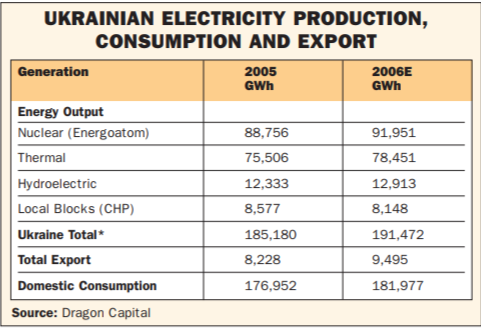
It may have made sense to make Ukrinterenergo a monopoly 13 years ago to get a single price for Ukrainian electricity. But now all the country’s voltage sold to Europe is produced at western Ukraine’s Burshtyn thermo-electric generating station, capable of generating 2,300 megawatts. Burshtyn is connected to Europe’s power grid and exports nearly 5 billion kWh annually.Last year, Ukraine exported almost 8.4 billion kWh of electricity, the Ministry of Fuel and Energy reported on March 7, adding that in 2006, Ukraine plans to increase electricity exports by over 20%, or almost 1.7 billion kWh, to more than 10 billion kWh. Of this, the ministry said, exports to Hungary will increase by 20%, to Moldova by 87%, to Poland by 22%, and to Romania by 40%. Exports to Slovakia will be more than doubled.