Two leading Ukrainian automakers to expand car production to Russia in a bid to capitalize on booming sales in that country.
The move represents the first attempt by Ukrainian auto manufacturers to break into a big foreign market.
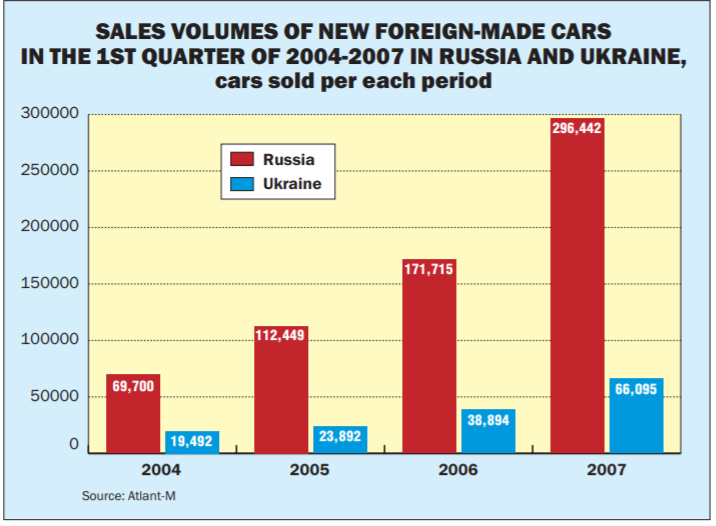
While the Ukrainian auto sales market has been also growing quickly, auto majors from the west and east have been setting their sites more on the larger Russian market, creating numerous joint production facilities in this market of 140 million in the last several years.
Auto production in Ukraine, mainly the assembly of Western and Asian brands, is largely controlled by domestic automakers, who are now eyeing a slice of the Russian market.
First in line are Bohdan Corporation and Ukravto Corporation, Ukraine’s two largest automobile producers and retailers.
In October 2006, Ukravto and Bohdan announced plans to unite efforts to expand onto the Russian market, and created a joint venture, United Transport Technologies (UTT), to sell their automobiles in Russia.
UTT on July 12 signed an investment agreement with Russia’s Economic Development Ministry to build a car assembly plant in Russia’s Nizhegorodskiy Region.
UTT bought a 50-hectare land plot for the new assembly plant last year.
The investment agreement was signed in line with a resolution adopted by Russia in 2005, according to which a company that manufacturers no less than 25,000 automobiles a year can import car parts for assembly in Russia free of charge or at a duty of 3 percent.
Within 30 months after signing an investment agreement with the Economic Development Ministry, a company must then limit the import of car parts, import them in line with regular rules, or launch the manufacture of those parts in Russia.
UTT director Maksym Kaplun told the Post by phone that after the 30-month period, the plant must be in full operation.
“Investments into the project total $335 million,” Kaplun said, adding that the company expects a return on the investments “within five years,” from the date that operations at the factory are launched.
International automobile holding Atlant-M concluded in research conducted in May that a trend has emerged on the Russian auto market over the last several years showing that the local assembly of foreign car models has risen from 10 percent of the total market in 2004 to nearly 25 percent in the first quarter of 2007.
These developments have made entering the Russian automobile market potentially lucrative for Ukrainian auto manufacturers.
When completed, the UTT-built plant will begin manufacturing Chevrolet Aveo and ZAZ Sens model cars, among others.
The plant also plans to manufacture Bohdan buses in the second stage of the project’s implementation.
The plant’s projected long-term production capacity is 160,000 vehicles per year.
UTT’s Kaplun said he expects the company to occupy a niche on the Russian automobile market, since “the volume of the market and its growth dynamics are very impressive, and the products that we make are absolutely in demand on the territory of Russian Federation.”
Ukravto, one of the two founding companies of UTT, has been assembling Daewoo and Chevrolet cars in Ukraine in line with a license agreement with General Motors since 2003. Bohdan specializes in the assembly of Russian VAZ passenger cars and minibuses using Isuzu parts.