Energy efficiency reforms badly needly
Still making the transition from winter holidaying to the economic demands of everyday life, Ukrainians are now wondering about their country’s natural gas supplies.
The price of blue fuel supplied to Ukraine from Russia and Turkmenistan has nearly doubled following a controversial agreement signed Jan. 4. The agreement to supply natural gas to Ukraine at $95 per 1,000 cubic meters (tcm) followed Russia’s cutting of gas supplies to Ukraine Jan. 1 and a fierce war of words between Moscow and Kyiv.
Critics, particularly in Ukrainian political circles, are lining up to condemn the terms that were agreed, but ultimately, beyond the doom and gloom, lie changes that were long in coming.
“Given that the Ukrainian economy is very energy intensive, the gas price hike will probably lead to a surge in inflation,” reads a special report on the issue from Raiffeisen Research, a part of the Austria-based banking group.
Prices for gas supplied to industry are expected to rise in the first quarter.
“After the elections, we expect that prices for households will also be raised, because otherwise the government deficit would increase too much,” the report reads.
Before the Jan. 4 deal, Ukraine had been paying just $50 per tcm for gas supplied by Russia. This so-called subsidized rate was largely paid through a barter settlement in return for the transit service that Ukraine provides for Russian shipments to Europe. Ukraine has in recent weeks stood firm, alleging it would not pay more than $50 per tcm, pointing to a previous contract. The new average price of $95 per tcm will be paid in cash rather than barter.
For its part, Kyiv raised its transit fees from $1.09 per tcm per 100 km to $1.60 per tcm. The deal is for five years. But the catch is that the agreement opens the door for Russia to call for a raise in gas prices for the second half of 2006. While both sides would have to agree to such a move, the transit fees are fixed for the entire half decade.
Enduring middlemen
Russian gas monopoly Gazprom and its Ukrainian state-owned counterpart Naftogaz Ukrainy can’t seem to manage the transfer of gas on their own. The delivery of gas from Central Asian republics and Russia will be handled by RosUkrEnergo, a joint venture between a Gazprom affiliate and a mystery beneficiary represented by Raiffeisen Investment AG (also affiliated with the banking group).
Additionally, RosUkrEnergo and Naftogaz plan to set up another joint venture to help handle the gas shipments. The usage of such intermediaries has been sharply criticized by many, among them former Prime Minister Yulia Tymoshenko, who has alleged the deal is linked with organized crime figures who are acting as parasites, siphoning billions of dollars in funds from the gas shipment operations which could partially go to Ukrainian state coffers.
Arrays of political forces have joined Tymoshenko in calling for the gas agreement to be cancelled through court litigation. Moreover, 250 deputies in Ukraine’s 450 seat legislature flexed their muscle Jan. 10, voting to oust the government of Yuriy Yekhanurov, largely in response to the signing of the controversial gas agreement. Industry lobbyists in Ukraine’s parliament have in recent days sharply criticized the gas price hikes envisioned in the Jan. 4 agreement.
Ukraine consumed just over 70 billion cubic meters of natural gas last year: 20 billion it produced itself, the rest it received from Russia and Turkmenistan.
Russia, which was heavily criticized by the West for using its gas to reign in stroppy former Soviet republics, yielded from its original price demand of $230 tcm, but in inking the deal has now given the shadowy RosUkrEnergo a virtual monopoly on all gas coming to Ukraine from Central Asia and Russia.
Ukrainian government officials plan to increase gas prices this year for households and industry. With less than three months before parliamentary elections, populist opposition political forces have pledged to prevent the price hikes. As of Jan. 11, it remained unclear whether they would succeed in preventing the gas price hikes. The fate of the Yekhanurov government, meanwhile, remained in limbo as of Jan. 11.
Economic aftermaths
Opinions are mixed as to what effect the new deal will have on Ukraine’s economy. According to the Raiffeisen report, the country’s chemical sector will become “nearly unprofitable” and the metallurgy sector will be at a “break-even level.” In short, Ukraine’s gas guzzling export industries, especially producers of fertilizers, of which gas comprises 70 percent of the end production costs, will suffer. Exports, supported by a devalued Ukrainian currency, have until this point carried the economy.
“Starting from April we expect an acceleration of inflation up to 17 or 18 percent year-on-year,” says Raiffeisen, and “net FDI inflows should suffer from weaker sentiment from international investors.”
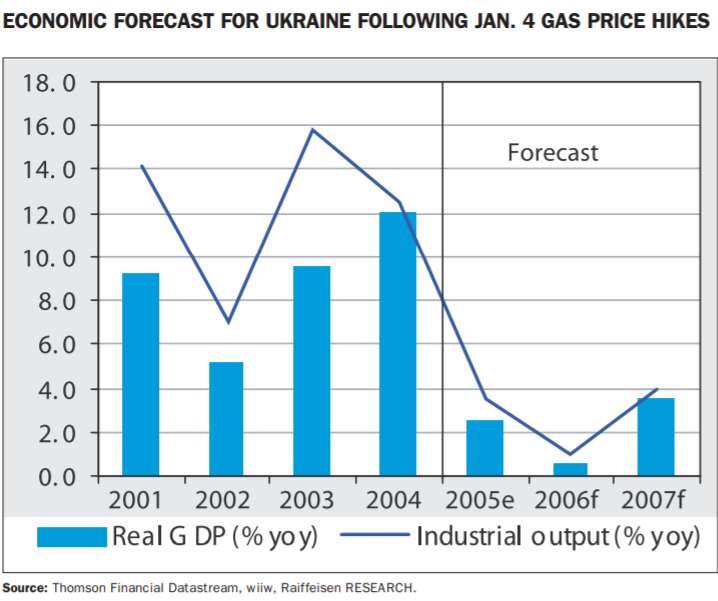
Compounding the problems, the lower hryvnia will in turn push up the cost of all imports, including gas.
With the elections looming, the government may try to apply restraints, but few now expect the optimistic GDP forecasts it made in 2005 to come true. According to a Jan. 5 Dragon Capital report, the hike in gas prices will result in a 1.6 percent decline in GDP.
“The overall effect of the new gas deal would still be negative for the economy and the trade balance in particular,” read the report. The result would be a 64 percent increase in gas import costs – to $5.51 billion – and a 46-percent rise in transit fees, to about $1.94 billion, ballooning the trade deficit to $3.57 billion (up 76 percent year-on-year).
Viktor Skarshevsky, an advisor to National Security Chief Anatoliy Kinakh, doesn’t deny the negative impact of the gas deal; however, he points out, the long term effects will have a bright side.
“From the standpoint of the economy, this will be a tough blow to economic growth. But it will be positive in the sense that the increased prices for gas will help encourage Ukraine’s industry to finally invest into energy efficiency technologies, decreasing their dependency on energy and increasing their competitiveness,” he said.
Ukraine’s industries have been inefficient gas users since Soviet times. Now, government officials say that they will be pumping less gas to such industries, encouraging them to burn other fuels temporarily, such as diesel and other oil-based fuels left over from the refining process. While these fuels will keep them running temporarily, the businesses will be encouraged to invest into energy-saving technologies, such as cogeneration, to become more efficient and competitive with European counterparts that consume only a fraction of the energy that Ukrainian factories do.
“You need to quit your addiction to drugs at some point,” Skarshevsky added. “In this sense, the higher prices will force Ukraine to make changes which are painful. The country’s industry will suffer from withdrawal syndrome, but in the long run the economy will turn out healthier and more effective.”
Anatoliy Starovoyt, general director of Ukrkoks, a coke industry advocacy group, told journalists this week that metallurgy giant Kryvorizhstal, purchased late last year in a repeat privatization auction for a whopping $4.8 billion, plans to reduce the use of natural gas in its production. He said that management appointed by Kryvorizhstal’s new owners, Mittal Steel, also plan to convert to higher-grade raw materials in order to reduce production costs and improve competitiveness.
Officials from other businesses have told the Post in recent days that gas shipments had been reduced, adding that government officials were encouraging them to diversify their fuel supplies.
John David Suggitt, managing partner at Concorde Capital, an investment bank, said that his firm saw no current threat to the Ukrainian chemical industry as a result of the increase in natural gas prices, on condition that chemical enterprises continue modernizing their production capacities and become more energy efficient.
He said that Stirol, one of the country’s biggest chemical plants, for example, would post profit margins higher than Concorde had forecast, despite the increase in gas costs. Over a year ago, the investment bank predicted that the price industrial enterprises would pay for natural gas in 2006 would be $85 per tcm. Following the recent gas deal, Concorde says plants such as Stirol will pay even a few dollars below this projected figure.
“We still see an upside of 25 percent for next year,” Suggitt said. However, by 2008, Concorde Capital predicts that natural gas will cost Ukraine $160 per tcm – the point at which he says that Ukrainian chemical production plants face the risk of possible losses if they continue producing at current efficiency levels.
“This is two years that Stirol and other companies in the chemical industry have to improve efficiency,” Suggitt said.
New opportunities
Another upside of the price hike might come from export industries that had been funneling their earnings to off-shore accounts, and which will now repatriate this money in order to survive. Most such industries, which take payments for goods in hard cash, have depended on cheap gas prices to operate. As the price rise, they will have to work closer to Western standards of efficiency and transparency or go under.
Some estimates put Ukraine’s shadow sector at more than 40 percent of the economy. Many plants currently report a marginal profit on products that they sell for higher abroad.
“If they want to work here in the future they are going to have to start showing their real earnings,” Skarshevsky said.
As for those firms that can’t survive with cheap gas, they could go under, opening new opportunities for outsiders. Or their local owners could opt to sell to larger foreign conglomerates with more financial muscle, which will help revamp the factories.“This could mean that new companies will start entering the market,” Skarshevsky added.