Orange coalition jointly holds more voter support
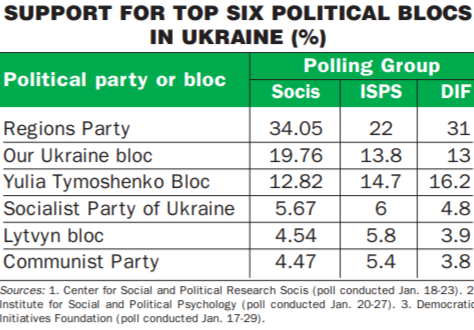
Ukrainian polling organizations have Viktor Yanukovych’s oppositionist Regions Party ahead in this year’s parliamentary election campaign with a safe margin.
The pro-presidential People’s Bloc Our Ukraine comes in second, followed by the Bloc of Yulia Tymoshenko – a former ally of President Viktor Yushchenko until he fired her as prime minister last fall.
Considering the polls’ margin of error, the two heroes of Ukraine’s Orange Revolution are running more or less even.
Altogether, six of the 45 parties currently registered with the Central Election Commission are expected to make it over the 3 percent hurdle needed to make it into the legislature, according to analysts. The Socialists, the Communists and parliamentary speaker Volodymyr Lytvyn’s bloc have good prospects for the March 26 election as well.
In addition, one or two underdogs might just slip by. These include radical left-winger Natalia Vitrenko, the leader of the Progressive Socialist Party of Ukraine; the Ne Tak group of Viktor Medvedchuk, presidential administration head under former President Leonid Kuchma and fierce Yushchenko opponent; the Yushchenko-friendly Kostenko-Plyush bloc, and Pora-PRP.
According to sociologists, all of whom conducted their polls last month, predict that little will change in terms of voting patterns adding that Yanukovych will likely come out on top.
“Despite the falsification of the election results during the presidential elections in 2004, Yanukovych has a lot of support,” said Pavlo Frolov, who chairs the Institute for Social and Political Psychology (ISPS).
According to the results of ISPS’s poll, Yanukovych leads Yushchenko by less than 10 percent.
A poll conducted by the Democratic Initiatives Foundation (DIF) put the gap between the president and his number one rival at almost 20 percent.
According to Ilko Kucheriv, director of DIF, the Party of Regions has been successful in mobilizing its electorate over the last several months.
But this does not necessarily increase Yanukovych’s chances of becoming the next prime minister. Political reforms that took effect this year shift key presidential powers from the presidency to the parliament, granting a majority within the nation’s legislature the power of forming the government.
While Yanukovych’s bloc has the highest voter support of all groups, they fall some 20 percent short of a majority. In contrast, Our Ukraine, Tymoshenko’s bloc and the socialists – all partners during the Orange Revolution – stand the highest chances of mustering enough joint votes to form a majority in the next parliament. Whether or not they put their differences aside or opt for a partnership with Yanukovych remains to be seen.
All pollsters agreed that the latest gas dispute with Russia, which is expected to directly affect Ukraine’s economy with higher gas prices, and the parliament’s subsequent no-confidence vote in Yushchenko’s hand-picked prime minister, Yury Yekhanurov, is unlikely to have an impact on voter preferences.
“About eighty percent of the population is already decided on their choice,” said Mykola Churylov, the head of the Center for Social and Political Research Socis, which conducted a third poll.
According to Frolov, the percentage of those still vacillating or currently supporting less popular parties may change, but they won’t alter the overall picture.
Geographically, voter preference has not changed since the 2004 presidential elections. The south and east, where Russian speakers are more common, support Yanukovych, while western and central regions prefer the “Orange politicians”, primarily Yushchenko and Tymoshenko.