Russian influence this time around expected to be limited
Western aid to develop democracy is once again gushing into Ukraine, in time for the March parliamentary elections.
The United States, Canada and the European Union account for the bulk of pre-election and democracy building technical assistance projects for the March poll. By far the largest donor of financial support for election-related technical assistance in Ukraine is the U.S.
An official with the U.S. Agency for International Development told the Post that the agency provided some $18 million to promote democracy in Ukraine for the 2004 presidential elections. Some of these funds were provided in earlier years, the majority arrived in 2004.
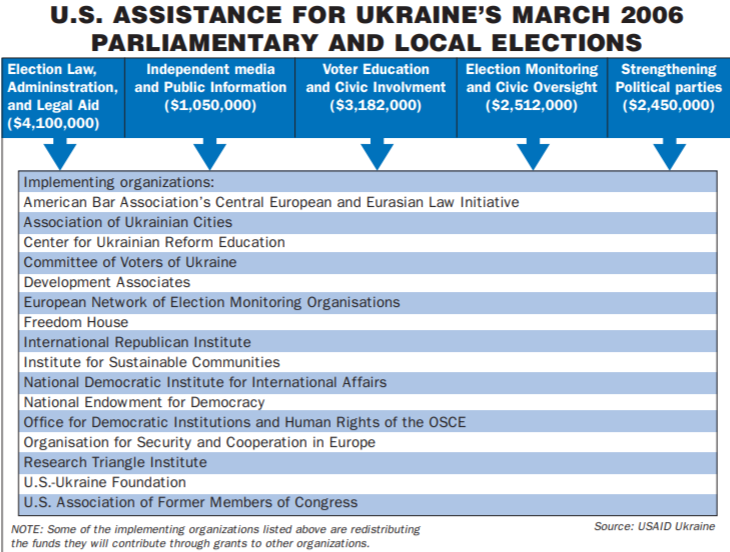
The stakes are also high this year. Documents obtained by the Post show that the total USAID budget for programs related to the March 2006 parliamentary and local elections is $11.1 million, with about $2 million in additional funds arriving from other U.S. government sources.
Kathryn Stevens, director of the office of democracy and governance at USAID in Ukraine, said that the funding “reflects the importance of these elections in shaping Ukraine’s future. This level is also consistent with emphasis in U.S. policy and development assistance worldwide on free and fair elections as a cornerstone of democratic systems.”
“We consider these elections very critical to Ukraine’s future,” Stevens added, because “Voters will choose their representatives under new elections laws, and for parliament, under a new fully proportional, party-list system.”
USAID funds are being granted to various NGOs involved in election projects directed at everything from election monitoring to voter awareness initiatives and political party strengthening. NGOs which received USAID funding include Internews, U.S.-based Freedom House, Eurasia Foundation, the National Democratic Institute, the International Republican Institute and the Ukrainian Committee of Voters.
Ukraine has long been a battlefield between Russia and the West, and the struggle for influence continues. Election assistance organizations from Russia and the CIS would appear to have placed their bets on opposition bloc leader Viktor Yanukovych, who lost the 2004 presidential election to the Western-minded Viktor Yushchenko by virtue of the Orange Revolution.
Russian role limited
But this year, election assistance and monitoring activities linked with Russia or affiliated CIS organizations will be limited at best.
And while conditions in Ukraine are favorable for Western foreign aid to flow into the country, the administration of President Viktor Yushchenko appears inclined to lessen Russia’s influence on its domestic affairs.
For example, Ukraine’s Foreign Affairs Ministry did not invite election observers from the CIS, largely influenced by Russia, to monitor this year’s parliamentary elections. Vasyl Fylypchuk, a spokesperson at the Ministry, explained the decision by pointing to their alleged biased role in the 2004 presidential elections, when they stood by results showing that Yanukovych had won, against more numerous claims by other international observers that the election had been falsified.
The activities of Western-funded NGOs in Russia are being curtailed following a recent law signed by Russian President Vladimir Putin that restricts all foreign NGOs.
Another example of Ukraine’s wariness of Russian influence in domestic politics is the recent refusal of Ukrainian authorities to allow Kiril Frolov, a Russian notorious for his anti-Ukrainian statements, into the country. On Jan. 27, Frolov, who works for the Institute for CIS Countries, was on his way to Crimea where he was supposed to deliver a lecture, when he was stopped by border guards in Simferopol and barred from entering Ukraine for two years.
Other donors
USAID is not the only organization to sponsor Ukrainian election activities.
The European Commission has allocated more than 1 million euros ($1.2 million) to help Ukraine’s Central Election Commission create a centralized electronic system of voter registration.
The International Renaissance Foundation, supported by George Soros’ Open Society Institute, is providing half a million U.S. dollars to mobilize civil society through support to Ukrainian think tanks, NGOs and media.
According to Ihor Kohut, the head of the Laboratory of Legislative Initiatives, which is in charge of the IRF program Conscientious Choice – 2006, the money will be spent on media projects, work by analytical groups, and local elections monitoring.
The Canadian Agency for International Development is donating about $530,000 to support voter education and NGO support.
The German Konrad-Adenauer-Stiftung, a foundation of the Christian Democratic Movement, has a smaller budget for improving democracy – about $100,000.
According to Ihor Plashkin, a program assistant at Konrad-Adenauer, the foundation runs several programs to develop civil society in Ukraine. Konrad-Adenauer arranges political debates, works with political parties and trains officials to work with mass media.
One of the newest donors in the Ukrainian non-governmental sector is the charitable foundation Kolokol (The Bell), which belongs to exiled Russian tycoon Boris Berezovsky. Berezovsky, a harsh opponent of Russian President Vladimir Putin, gave a total of $266,000 to 20 Ukrainian NGOs for election-related activities.
Analysts say that the last several years have seen a considerable increase in political involvement among the Ukrainian populace. Foreign aid has been tied to this trend.
“Ukrainian civil society has become much more mature in the last several years. It not only played an active role in promoting fairness in the 2002 and 2004 elections, but it is now working to monitor how new authorities are implementing their electoral promises,” said Dr. Oleksiy Haran, Eurasia Foundation’s regional vice president for Ukraine, Belarus and Moldova.
Konrad-Adenauer’s Plashkin agrees, saying that NGOs are now not only politically active but proactive.