Historic justice happens. The monument to national poet Taras Shevchenko in central Kyiv is a case in point.
It now occupies the spot that used to be taken by the Russian Emperor Nikolai I, the Romanov Dynasty czar who had once sentenced Shevchenko to 10 years in exile.
The story is particularly worth remembering during a time when injustice and impunity seems to be all-pervasive again. It’s also worth remembering this month, in the wake of celebrations of the life of Shevchenko, who was born on March 9, 1814 and who died on March 10, 1861.
The modern-day Shevchenko Park is a lively place for all. Students from the nearby university (also named after Shevchenko), flock to take their breaks here. Employees of local offices pop in at lunch hour to eat on a bench, in a cafe or the Ukrainian cuisine restaurant O’Panas.
Children come to play at the playground, while grandpas play chess in a corner of the park.
Among the other attractions: the oldest public toilet, a fountain shaped like the Black Sea, a modern sculpture of a babushka sitting on a bench.
The park might have enjoyed the same popularity in the old days, but its name and its main set of attractions were different.
Some historians say that the park courtesy of Emperor Pedro II of Brazil. When the Brazilian guest visited Kyiv in the late 19th century, he saw cows and pigs feeding on a vast field in front of the red campus of the university that had been founded in 1834.
Unimpressed with the view, he advised the Kyiv governor to set a park in the space. University Park was laid in 1887. The trees were planted and alleys paved. As the university was opened under the rule of Nikolai I, it was his statue that became the central element here in 1896. The park then changed its name to Nikolayevsky.
But neither the Russian czar, nor the Ukrainian bard Shevchenko were alive at the time they were glorified in the park.
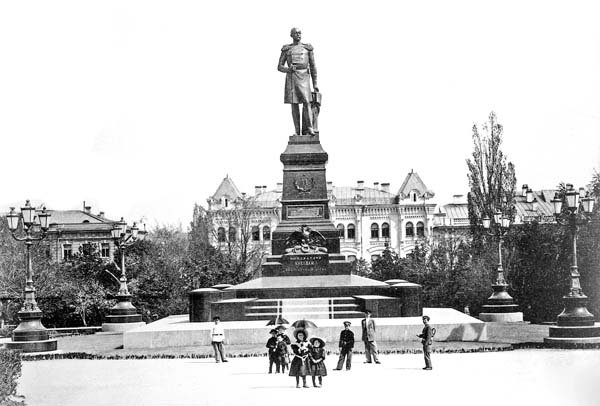
In this late 19th century photo, Czar Nikolai I proudly occupies the pedestal in the park renamed now as Taras Shevchenko Park. (Courtesy)
Shevchenko, in fact, was one of those who had witnessed that empty field in front of the university. When he made a pencil scratch of the view in 1846, he was already an aspiring artist taking classes at the St. Petersburg Academy of Art.
By that time he had already been bought out of serfdom by his friends in the Russian capital, who were amazed by his many talents. He was already a recognized poet since his Kobzar, The Bard, a collection of poems about Ukraine, and a second Bible for many Ukrainians, was published in 1840.
Shevchenko applied for a job at the Kyiv university when he came back here. In February 1847, he was hired as a drawing teacher. It would have been a good start of his academic career had he not been arrested a few months later for membership in a secret society, the Saint Cyril and Methodius brotherhood, and for writing anti-czarist poems.
Czar Nikolai I scribbled with his royal hand on Shevchenko’s verdict that he has to remain “under strict supervision and with a ban to write and draw.” Shevchenko was exiled to the military service in Orenburg Region, Russia, and then to Mangystau Province, in modern Kazakhstan, where he spent a decade of his life.
Despite the ban and hard living conditions, Shevchenko continued to paint and to write verses, contributing greatly to Ukraine’s cultural heritage.
Two years after Nikolay’s death, Shevchenko’s friends managed to bring him back from the exile. Shevchenko always dreamed about living in Ukraine, but years of exile and military service, as well as another arrest later on, undermined his health.
He died in St. Petersburg, but later was reburied in Kaniv, 150 kilometers southeast of Kyiv. When a cart with his coffin was crossing the Dnipro River, students from Kyiv released the horses and harnessed themselves to show their respect to the great man.
In 1904, fundraising began to build a monument to Shevchenko, and a few years later the Kyiv city council gave permission to erect a statue. But World War I and the October Revolution halted these plans. The Soviets ended up building today’s monument.
In 1920, soon after taking power in the city, they demolished the monument to the czar and changed the name of the park to the Red Park. In 1939, the name changed again, as the Shevchenko statue finally replaced the czar’s.
Despite the fact that that the 19th century depiction of the Russian emperor looked more exquisite and elegant compared to the slab of Socialist realism, it seems both the czar and the poet got what they deserved in the end.
Kyiv Post staff writer Oksana Faryna can be reached at [email protected].