Destination: Certisoara
Starting Location: Balea Lac, Faragas Main Ridge
Today’s Kilometers: 19.00
Trip Kilometers: 523.75
1100 GPS: Didn’t check, but at the top of the Faragas
And that is: More specifically, at the cable car building about 200 meters from the Cabana Balea Lac
Altitude: 2030 meters, give or take a few
End of day GPS: Didn’t check
And that is: Edge of village Certisoara, not far from Route 1
Altitude: Maybe 1,200 meters
Distance advanced: 19 km by foot, another 15 or so by auto
Ok, for better appreciation of today’s post go here –
http://www.topgear.com/uk/videos/brand-new-clip-tg-goes-to-romania-part-6
where you will find a piece of an episode of Top Gear, a BBC-show which pretty much every one in Europe has heard of.
Those of you in the States who haven’t, Top Gear is about cars and features three English guys driving shiny expensive ones, usually fast. Sometimes they go outside of Britain to do pieces on this or that car or road, and the linkie above is a piece of the Top Gear segment on Romania’s Faragasan highway.
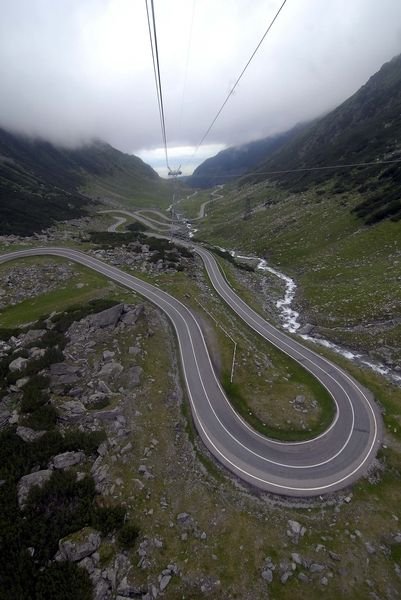
The shortest distance between two points? Actually walking this thing I cut a lot fewer corners than you would think, the grass was friggen’ wet and after 20 meters already my boot suede was getting saturated. Stick to the asphalt and kick it was the solution. Sunday, June 27, 2010
The Top Gear presenters drove a Lamborghini, a Maserati, and a Austin-Martin on the Transfargasan highway, and as you can see that produced some very pretty video.
I can fairly say I have walked the Transfaragasan, from top to bottom. My pictures are not quite so exciting, but then, I don’t quite have the resources available to me that the BBC’s top-rated TV show has. And being on foot gives you a different perspective.
But first things first. I got up, had my extensive semi-Socialist breakfast of ham, salami, sliced cheese, sheep cheese, black olives, jam, butter, bread, sliced tomato, peeled cucumber spear, and urn coffee, packed up, and since the fog had indeed not broken wound up at the top end of the Faragas mountain cable car line, at the reasonable hour of 1030 am. Earlier would have been pointless, no way it would run earlier than that.
And as it turned out, nor afterward as well. It took some searching, but eventually I scared up a young man in a back room of the cable car building, who said the cable car might run later today, but if I wanted to go now, I had to pay the fare of a full car, which would be 10 people or the equivalent of 30 dollars.
It was foggy, but – in what is becoming the theme of this hike – it wasn’t actively raining, and so it was by definition excellent walking weather. It was 12 kilometers downhill to the tourist station Balea Cascada, maybe I could pick up a ride there. So at 1100 I saddled up, walked past the roast corn and curios vendors that have stands right where the Transfaragasan tops onto the Faragas ridge, and followed the road downhill.
The road is a blacktop two lane built by Romanian dictator Nicolae Ceausescu in the 1970s, in response to the Soviet invasion of Czechoslovakia in 1968. The idea was, the road would enable Romanian’s military to move troops across the Faragas mountains fast, in case the Russian decided to invade their fraternal Socialist partner Romania.
It was a classic huge Socialist engineering project, using a bazillion tons of concrete and dynamite and steel reinforcing (you want the numbers, Wikipedia is your friend), and I can certainly say that there are plenty of villages in Romania with plenty of houses put up in the 1970s, with dirt streets because the government had other plans for the cement.
The Faragas as we now all know thoroughly are quite a wet mountain range, and so the main engineering challenge when building the road was not really where to lay the route, you get enough traverses and abutments and you can drive up the Matterhorn. The problem is rather, how to keep the road from getting washed away by the rain and mud and snow.
I would up walking the northern leg of the Transfaragasan in two parts, southward from Route 1 to Balea Cascada on one day, and then northward from the top of the ridge down past Balea Cascada on another. It is true I cut the corners of a few hairpin turns, but otherwise pretty much every meter.
The road, when you walk it, is not a triumph of road engineering, as I believe the Top Gear presenters describe it to be. Rather, I would call it a temporary ascendency of road engineering over nature, which will overwhelm the road pretty damn soon using cold, water, and gravity, because no engineer in his right mind would commit the resources to maintain it, and even nutty Communist dictators probably couldn’t find the resources even if the engineers thought it was a worthwhile idea.
It is not so much a road as a water control system. There is a granite-lined drainage ditch along the Transfaragas’ length, and in heights above 1500 meters there are buttresses and canals and spillways at just about every turn. You walk the road in a rainy late June, and even without the cars (and there aren’t many) the road is far from silent. Everywhere, there is water, dripping from the mountain sides, pouring through sluices running over a road cover, or cascading in a white stream pretty much hell-bent on moving boulders and whatever else it can grab, to trash the road.
At critical locations the Romanians used steel fencing, much like giant chicken wire, to hold the loose rocks in check. At some of these places, the rocks are winning, they’ve punched holes in the wire, and television-size chunks are on the edge of the road.
At very critical locations, which make by the way for dramatic photo backdrops, the Romanians have built reinforced concrete roofs to keep off the rocks and water. Inside, water is making its way through cracks, and you can see here and there where sooner or later the dirt and rock holding a support column is going to give way. It’s like a Popsicle stick building stuck together with white glue up against a tide: sooner or later Nature is going to level it.
I saw crews repairing the road at a couple of places, and they were just digging out the worst potholes and then filling them in, in good Soviet fashion. I don’t know what the Romanians can do to keep the road open in the long term, they can maintain it, but in another 20-30 years the whole thing is going to be so rotten they’ll have to tear it out and replace it, and how do they do that without a Communist dictator?
But as it exists, it’s certainly impressive. It took me about 3 kilometers to get out from the fog, and then it was pretty cool walking, I could see cars coming all the way down to the wood line, maybe 8-10 kilometers away, and what with the grade and the switchbacks, I could watch them for a good long time before they actually met me.
Some of the motorists waved, but more took pictures of me. I had become a part of the peculiar scenery.
I moved at (for me) record speed, maintaining a 5 kph pace without any effort at all. I swung into the first planned stop, Balea Cascada, at about 1315, a good 30 to 40 minutes ahead of what I expected; this mostly due to the steep downgrade, but also to the fact that for the first time in more than a week, I was able just to walk unimpeded.
It was fun to swing past the tourist stalls at Balea Cascada, drop pack next to a little cafe, and be the tough hiker down from the real mountains, as the tourists bought souvenirs and waited for the cable car (which got going around 1130) to send another car upwards.
There was a group of Germans in full mountain kit, with a Romanian Salvomonte guide, at the cafe as well, they had dropped all their stuff all over the tables. From their conversation they had been on the high ground either this morning or yesterday, and were not overly pleased with the weather conditions.
I politely asked if I might sit down at one of the tables to eat my hot dogs and chocolate. They politely made space, but made no more conversation, so no points for the international hiking community there.
I got moving again quickly, and was making even more good time, I was really flying, and even a start of the traditional afternoon drizzle didn’t really bother me. I knew the village of Certisoara was about 10 – 15 km away, there were plenty of places to stay there, I was moving fast, my pack was light, and the trees gave some cover.
But Romania had other plans for me. A big Mercedes goes by, stops, rolls down its window, and inside are two attractive-looking young people, Christian and Anna. Christian is a glasswares salesman from Cluj, Anna is a marketing major at Cluj university. Their English was excellent, and they seemed not to have banked on finding an American hiking down the Transfaragasan. They were staying in Certisoara for the night, and tomorrow they were traveling to Sibiu, where my bounce box with computer and clean socks etc. was located. How about a lift?
I agreed, on grounds I had already made up the part of the Transfaragasan I hadn’t walked previously, and also road walking in the rain for the sake of proving a point has lost some of its appeal to me.
I looked back up at the Faragas as we drove down into the valley. Completely, totally, absolutely socked in, big black clouds all along the entire ridge. Only a moron would try and walk around up there under those conditions, and now, it was somebody else’s turn.
"Boola Boola!"
Stefan Korshak is a reporter and blogger at Trail Journals. You can read his blog entries at http://www.trailjournals.com/entry.cfm?id=311030