Editor’s Note: The following assessment is from Kyiv Post journalists who attended the 14th annual Yalta European Strategy in Kyiv, held Sept. 14-16, and sponsored by Ukrainian billionaire oligarch Victor Pinchuk. For the third year, the Kyiv Post was an event media partner. Videos from the event are available at yes-conference.org
WINNERS
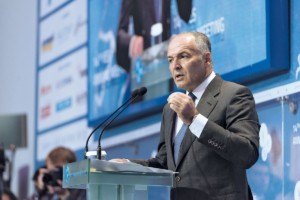
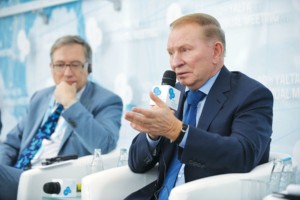
Victor Pinchuk & Leonid Kuchma
billionaire oligarch, president of Ukraine (1994–2005)
Victor Pinchuk, the billionaire oligarch and his father-in-law, ex-President Leonid Kuchma, came through the 14th annual Yalta European Strategy conference smelling like roses.
The event took place from Sept. 14–16, with nary a word heard about how Pinchuk got rich under his father-in-law’s tenure as president. And the 17th anniversary of the murder of Georgiy Gongadze, killed on Sept. 16, 2000, wasn’t mentioned even once. Although he has always denied it all, Kuchma is not only the top suspect in ordering the murder of Ukrainska Pravda’s founder, his law enforcers obstructed the probe during his decade of misrule and plunder in which Ukraine lost its chance to join the European Union and NATO as everyone else in the neighborhood was doing so.
That was then; this is now. YES has not worked out the way that Pinchuk or Ukraine hoped when it started in 2004, as the name of the conference makes clear. Since Russia stole Crimea in 2014, the event has taken place in Kyiv.
After years of spending generously on honorariums to land big-name stars, Pinchuk probably knows personally more current or former presidents, prime ministers, secretaries of state and CEOs than anyone else in Ukraine.
His persona and political positions, including a controversial Wall Street Journal op-ed suggesting Ukraine should find a compromise with Russia on the Crimean question, trigger periodic backlashes — including an announcement of the start of an anti-YES conference next year in Ukraine.
The Kyiv Post has changed its position on Pinchuk and YES over the years, going from boycotting the event to becoming a media partner. If this makes us sellouts, the fact remains that YES is the best conference in Ukraine (after the Kyiv Post Tiger Conference, in our biased opinion). YES has raised the profile of Ukraine internationally in a positive way. As for Pinchuk’s philanthropy, many Ukrainians have benefited from his annual scholarships. And, in the interests of full disclosure, the Kyiv Post found common cause in partnering with Pinchuk on this year’s Top 30 Under 30 Awards ceremony at the Dec. 5 Tiger Conference.
After three years as YES media partner, however, the illusion of access to the star guests is stronger than the reality. In fact, many of the questions from the audience are pre-screened, taken from the elite sitting in reserved seats and few in number. Several dignitaries also come to the event, speak and leave without talking to any journalists.
John Kerry
U.S. secretary of state (2013–2017)
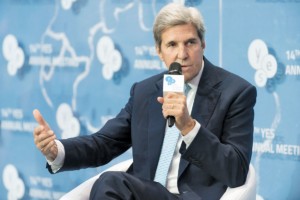 John Kerry diminished his YES performance with his touchy-feely advice to understand why Russian dictator Vladimir Putin invades neighbors and is, in general, a global menace. But Kerry redeemed himself by taking on President Petro Poroshenko over his failure to fight corruption. Poroshenko contemptuously dismissed the idea that independent anti-corruption courts are needed in Ukraine, saying that they are used only by poor African or Asian nations, not in European democracies. His over-the-top question: Raise your hand if you are from a country with an anti-corruption court? “You see, no one.” When he got to the stage, Kerry responded by saying “in my country, every court is an anti-corruption court.” He urged Ukraine’s leaders to take seriously the fight against corruption, which obviously they are not doing, considering that no one has been convicted of corruption in Ukraine courts.
Stephen Sackur
Host of BBC World News HARDtalk
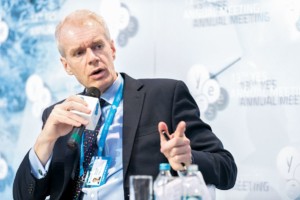 For three years running, Stephen Sackur has flustered Ukrainian politicians by asking one simple question: Name one big fish convicted of any crime or corruption? Since there are no success stories, politicians don’t know how to respond — other than to promise that tomorrow, next year, some day, one day, they will start battling corruption. The other variation in the answer is that they blame the failure to fight corruption on someone else. Or they talk about Ukraine’s difficult history. Sackur is always a solid moderator, a real journalist who does his homework and cuts through bullshit answers. But the problem with the Pinchuk forum is that Sackur usually grills prime ministers — first Arseniy Yatsenyuk and now Volodymyr Groysman — on corruptione. Pinchuk should have him grilling Poroshenko, who controls the prosecutors and judges. Instead, Poroshenko gets nothing but softball questions each year and that is probably by presidential demand.
Svitlana Zalishchuk
Member of the Verkhovna Rada, Ukraine’s parliament
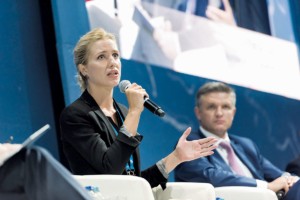 During a dinner-time discussion, it was interesting to hear Svitlana Zalishchuk, one of Ukraine’s brightest political stars, confess to feeling like an outsider inside parliament, where she is a member of the dominant 135-member bloc of President Petro Poroshenko.
“We are all invitees in the parliament and government. This is our status still. We have to admit that we are troublemakers rather than decisionmakers. We all know how to make reforms, but we don’t know how to win elections. But there’s no alternative. We’ll keep on criticizing the president, the parliament, government for not adopting the anti-corruption court and so on until we win elections ourselves.”
And she blasted Poroshenko, saying: “Unfortunately, the president did not become that proper instrument for Ukraine to overcome the problems we face.” She wasn’t alone in calling him a liar. Noting that Poroshenko earlier in the day said he “doesn’t want to wait 1.5 years to establish” an anti-corruption court. “This is simply not true. The law on anti-corruption court was registered Feb. 1. We could have already had commissions working nine months to elect the judges. There is no will to establish an independent anti-corruption court. Why? It will go after anyone in the country. That is the fear that is there.”
The problem is that Ukraine’s leaders “want to be judged by what they say, not how they act.”
Mustafa Nayyem
Member of the Verkhovna Rada, Ukraine’s parliament
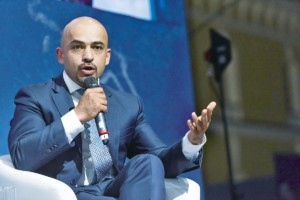 Mustafa Nayyem deserves credit for calling out people by name. He blamed billionaire oligarchs Rinat Akhmetov and exiled Dmytro Firtash for excessive and unfair profiteering by manipulating government policies in energy supplies. Nayyem said that the leaders of three main factions in parliament — President Petro Poroshenko and ex-prime ministers Arseniy Yatsenyuk and Yulia Tymoshenko — could get lots of reforms passed, including electoral reform, but they are not interested in what’s good for the nation but rather what’s good for themselves. “They’re stealing our future,” Nayyem said.
Nayyem said that getting elected is beyond the reach of most political candidates, unless they are backed by billionaire oligarchs. He estimated that it costs $3 million to $5 million to win a seat in parliament and hundreds of thousands of dollars to win at the local and regional levels.
“The resources of our country are concentrated in five to seven hands,” Nayyem said. He didn’t mention them by name, but based on wealth alone he most likely meant Akhmetov, Firtash, Poroshenko, Victor Pinchuk, Igor Kolomoisky, Gennadiy Boholyobov and Yuriy Kosiuk.
Nayyem called on young people to stay in the nation even as “many are leaving the country because of the good future outside of Ukraine.”
He said parliamentary immunity from criminal prosecution must be removed since 80 percent of MPs sought election to “protect themselves, to protect their assets — not to make changes.”
“If we will not start to fight corruption in the real sense of this word…people will be disappointed.”
Condoleezza Rice
U. S. Secretary of State (2005–2009)
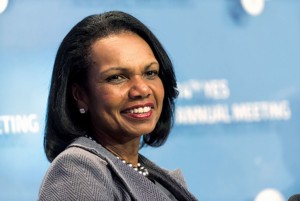 Condoleezza Rice, who has visited Ukraine several times, drove home the point that Ukrainians cannot expect anyone else to help them. The West’s sanctions against Russia aren’t going to last forever, she warned, so Ukraine needs to take advantage of this time to get its own house in order — including in the energy sector, where she said corruption needs to be eliminated, regulations improved and domestic gas and oil production increased.
“We can’t do it for you,” she said. “You have to find a way.”
She suggested greater use of social media to raise small donations, the way ex-U.S. President Barack Obama did, “to break through the funding requirements.”
“Unless you connect to the people, you will quickly find you have no one following you,” Rice advised. After revolutions, the “really hard works starts at that moment: institutionalization of your freedoms, having a parliament that balances the president, an independent judiciary, a press that is free and that can hold elected officials accountable. How is Ukraine doing in becoming an institutionalized robust democracy?”
And she warned: “What are you going to do about it so that when we’re back here in a year or in the next few years, winter hasn’t overtaken Ukrainian politics?”
Pat Cox
President of the European Parliament (2002–2004)
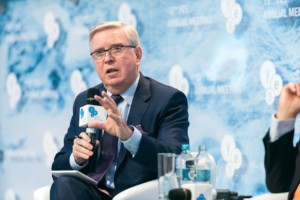 Pat Cox, a member of the YES board of directors, deserves credit for steering the conversation back to the lack of electoral reform and the need for a new Central Election Commission ahead of the 2019 presidential and parliamentary elections. The legal mandate for the current commission expired, yet President Petro Poroshenko is keeping its members in place, including Mykhailo Okhendovsky as chairperson. Okhendovsky is a holdover from disgraced ex-President Viktor Yanukovych and implicated in bribery and election rigging charges that he denies. Instead of removing him, as Mustafa Nayyem pointed out, Poroshenko gave him a medal of honor.
Cox closed by saying: “I believe in you. Believe in yourselves and your country.”
Dmytro Shymkiv
Deputy Head of the Presidential Administration
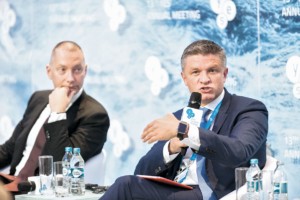 It wasn’t his aim probably, but Dmytro Shymkiv rattled off a long list of unfinished reforms that proves the point of critics of the president and parliament. Among them: Pension, medical, privatization, state fiscal investigation, anti-corruption court, budget, electricity market, decentralization, election law, roadbuilding and more. “My list is pretty big,” he said. “You keep walking.”
When Shymkiv was finished, Mustafa Nayyem asked him if they were living in the same country with the same parliament, which has obstructed many of the items on Shymkiv’s list.
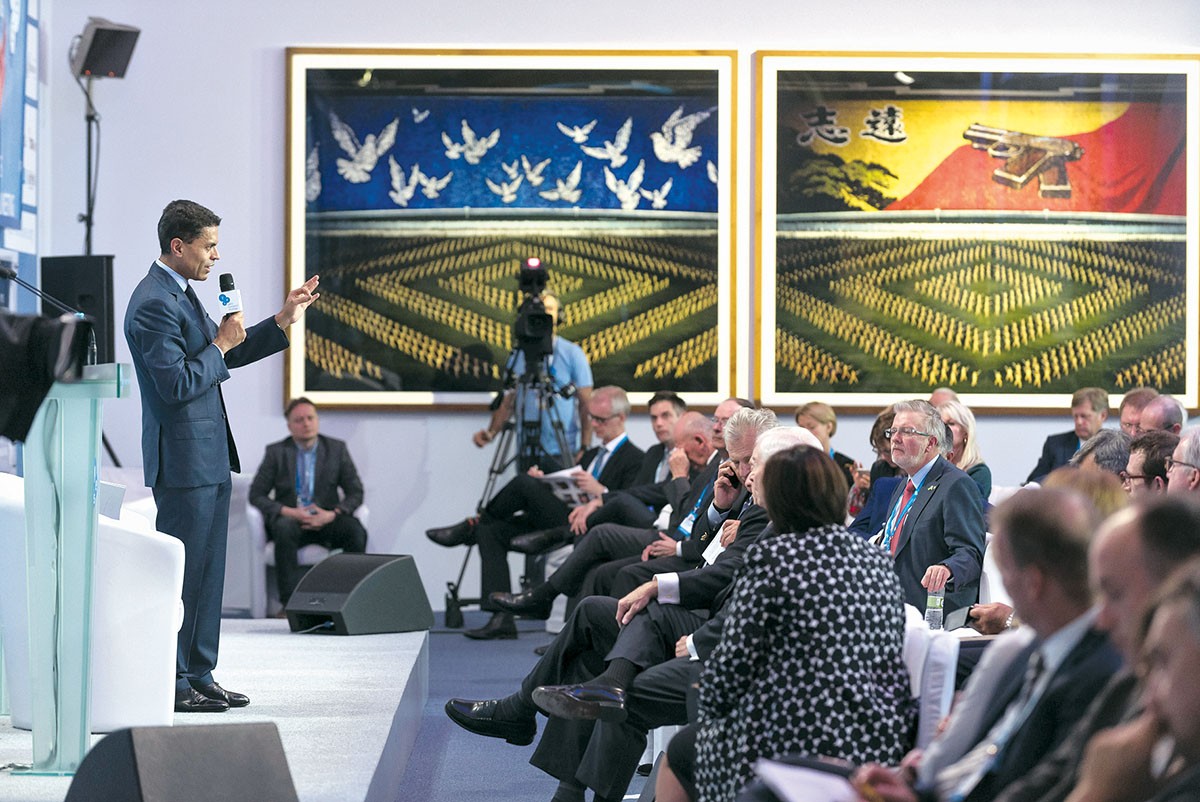
CNN host Fareed Zakaria speaks at the 14th Yalta European Strategy meeting in Kyiv. (Aleksandr Indychii/YES)
Will Hurd
Republican Party member of the U. S. House of Representatives (Texas-23rd District)
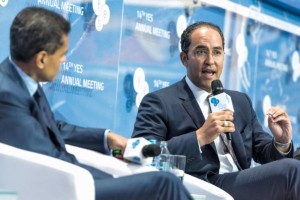 Will Hurd, a former undercover officer in the U. S. Central Intelligence Agency, wowed the audience with his clear analysis of the situation in Ukraine, compared to some mealy-mouthed speakers on panels.
“The first thing that this administration can do is sell lethal weapons to the Ukrainians,” Hurd said. “The closer you are to Russia, the less likely you are to believe their nonsense. But the converse of this rule is true as well. The farther you are, the more likely you are to be susceptible to their disinformation…It’s absolutely clear the Russians tried to manipulate our elections.”
On only his second trip to Ukraine, Hurd also understands Russia’s war quite well: “I started getting upset when people started to use the term ‘separatists.’ What is happening in eastern Ukraine and Crimea is not a separatist activity, it is an invasion of a sovereign nation by the Russians. Period. End of story. We do not need U.N. peacekeepers to resolve this issue. The resolution is simple: Vladimir Putin should take his 920 tanks and all the Russian military and leave. That is how this should be resolved…The Russians are not our ally. They are our adversary. We have to be prepared to counter their asymmetrical warfare and one place to do that is right here in supporting our friend and ally, Ukraine.”
Robert Gates
U.S. secretary of defense (2006-2011)
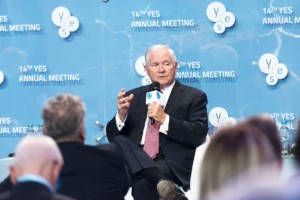 Former U.S. Defense Secretary Robert Gates followed his visit to YES last year with another strong appearance. In a panel discussion about U.S. foreign policy, he proved to be a moderating presence, throwing cold water at one point on the notion that previous administrations somehow forgot that U.S. interests existed: “Every president in our history has pursued both our values and our interests.” With respect to Ukraine, he also clearly set out the main challenge for President Donald J. Trump’s foreign policy: “How to push back against (Vladimir) Putin’s interventionism not only in Ukraine, but in political activity in Europe and the United States.”
Kurt Volker
U.S. special envoy to Ukraine
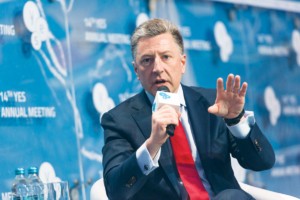 Despite Ukraine’s worst fears about Donald J. Trump’s presidency, the appointment of Volker in charge of peace talks with Russia showed strong support for Ukraine. At the YES meeting, Volker said that he was determined to give impetus to the failing Minsk peace process without replacing it. He also saw an opportunity for dialogue in Vladimir Putin’s proposal of a United Nations peacekeeping mission to the Donbas. “Russia’s proposal could only deepen the divide in Ukraine. But the fact that they did it is a step forward. It never happened before, and it indicates that Russia senses the status quo isn’t good for anybody,” Volker said.
LOSERS
Petro Poroshenko
President of Ukraine (2014- present)
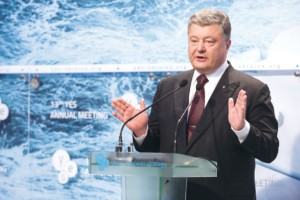 He was at his arrogant and misleading best in becoming the No. 1 loser at YES for mocking the idea that Ukraine needs an independent anti-corruption court, which he’s obstructed, as he has any other meaningful changes of Ukraine’s legal system that would allow judges, prosecutors and police to conduct a genuine fight against corruption — not the imitation one under way now.
With his shameful stunts, Poroshenko proved he’s the nation’s top obstructionist to battling corruption.
“Is the situation significantly improved? Definitely,” Poroshenko claimed of the fight against corruption. He also claimed that the business community is enthusiastic, based on his recent closed-door meeting with members of the European Business Association and American Chamber of Commerce. He said member businesses are planning to increase their investment in Ukraine up to 30 percent and that all five funds he was told about are fully subscribed with investors. (The Presidential Administration approved the guest list. The Kyiv Post, an AmCham and EBA member, was excluded from the event.)
He claimed every single week there is an arrest of “high-ranking corruptionists” — neglecting to say, of course, that no one has been convicted. He claimed credit for making public the value added tax refunds and declarations of public officials’ assets and income, even though he tried to sabotage both initiatives. He also extolled the imminent creation of an “absolutely new Supreme Court” of 120 members which, critics say, will consist mostly of the same old discredited justices.
“For the anti-corruption court we have registered the draft law,” he said. “I don’t have 1.5 years or two years to wait for an anti-corruption court. I want to ask all of you: Could you raise the hand if in your countries exist an anti-corruption court, in any of your countries. Maybe in France, England, Poland, Germany or maybe the United States? Maybe. No hands. In what countries do they exist…Kenya, Uganda, seems to me Malaysia, and in Croatia.”
This was his most cynical and disgraceful ploy. He has been obstructing the anti-corruption court from the start. And he knows that the problem in Ukraine is that the courts are untrustworthy and unable to deliver just verdicts in Ukraine. This is the way Poroshenko wants it — he does not want an independent judicial system or anything approaching U.S. style justice in which a special prosecutor could investigate a sitting president.
Yuriy Lutsenko
Prosecutor General (May 12, 2016- present)
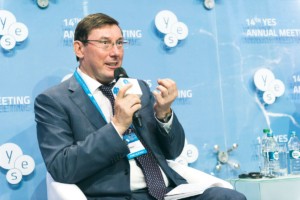 Red-faced and impassioned, Yuriy Lutsenko came across as a clown and the chief accomplice to President Petro Poroshenko’s failure to combat corruption and dislodge Ukraine’s oligarchy. He reeled off meaningless statistics — 4,000 cases of bribery — but said he can’t convict anyone because none of the nation’s useless and corrupt judges will take the cases to trial. He then said he needs an anti-corruption court “tomorrow.” His performance would have had a shred of credibility had Lutsenko and Poroshenko not teamed up to sabotage the creation of the anti-corruption court. This non-lawyer and non-reformer should resign. He vaulted to political fame by taking 0n ex-President Leonid Kuchma, but has become a complete sellout to the oligarchy. We are deeply disappointed in him because we championed his freedom during his imprisonment on trumped-up charges under ex-President Viktor Yanukovych.
Richard N. Haass
President of the Council on Foreign Relations
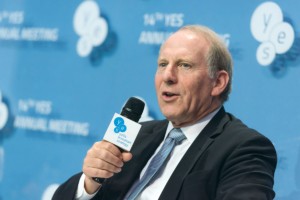 A former adviser in the George W. Bush administration, Richard N. Haass needs to be replaced as a moderator. Haass threw nothing but lame softballs to Poroshenko. “A consistent refrain was dealing with corruption…how do you respond to that?” Then he hosted a panel on how Ukraine can regain control of the Russian-occupied Donbas and Crimea. He didn’t know what the Mejlis, the council of Crimean Tatars, was. Introducing Mejlis chairman Refat Chubarov, he said: “I have no idea what that organization is.” His ignorance didn’t stop him from declaring that regaining Crimea is not “a viable, serious, near-term policy proposition…given the realities on the ground, realities in the Kremlin, and given other priorities.”
Tony Blair
United Kingdom prime minister (1997–2007)
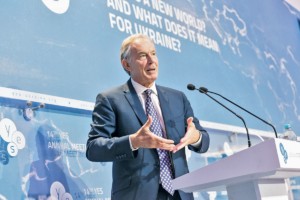 Since leaving office in 2007, Blair has been raking in the big bucks by peddling his nonsense and cozying up to dictators. He has no credibility anymore. His transgressions include advising Kazakhstan dictator Nursultan Nazarbayev on damage control after a massacre. By the time he made it to this year’s YES conference, he seemed completely out of ideas, offering bromides about prosperity, Ukraine’s European destiny and how it takes both sides to make peace and end war.
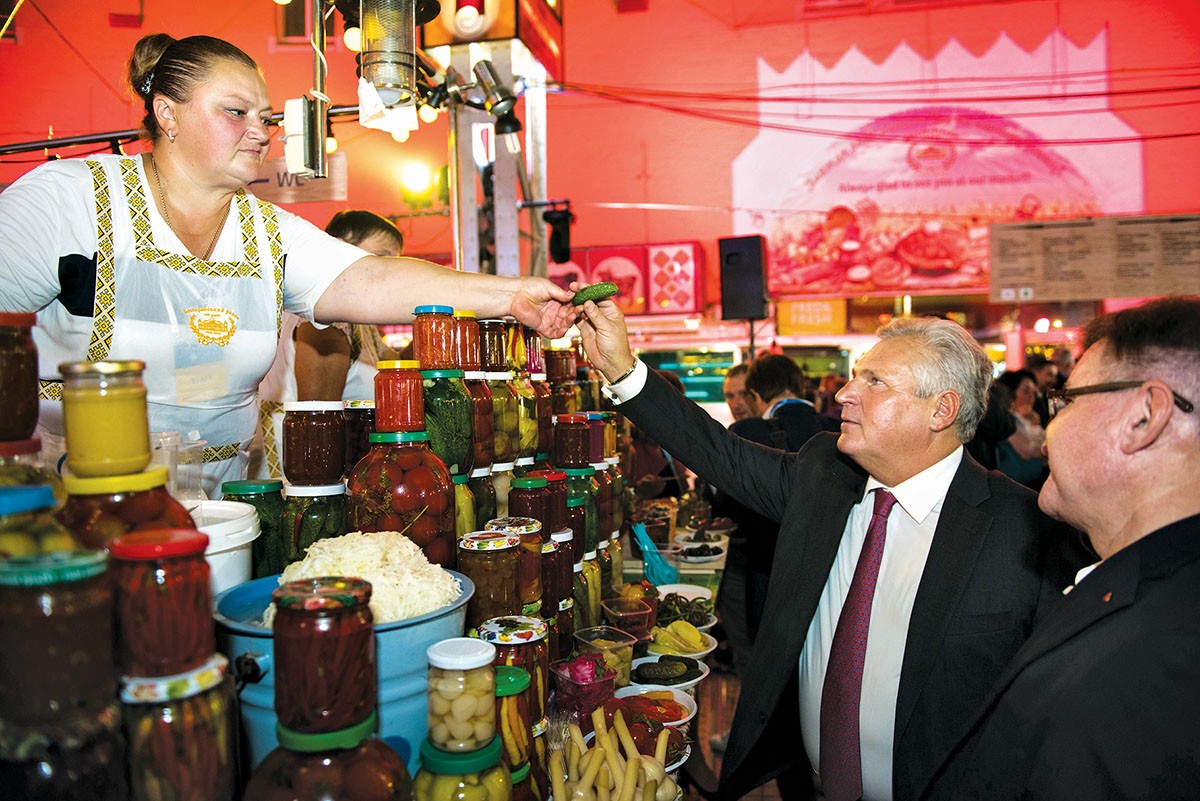
Former Polish President Aleksander Kwasniewski tries a cucumber during the welcoming reception at the Sept. 14 opening of the 14th annual Yalta European Strategy conference in Kyiv. (Sergei Illin/YES)
Alexandr Kwasniewski
President of Poland (1995–2005); Chairman of the YES Board
 Alexandr Kwasniewski closed out the YES forum with a speech that everyone wanted to end. Trotted out on an annual basis by Pinchuk, Kwasniewski joined the ranks of other notable attendees by adding nothing to the conversation. The former Polish president had to close the event — an admittedly difficult task.
“Corruption is the real problem of this country. But corruption is also damaging the image of Ukraine, this is the brand that you have to change as soon as possible,” Kwasniewski lectured at the end.
Kwasniewski should start with himself. He is on the board of directors of Burisma energy company, run by ex-Ecology Minister Mykola Zlochevsky of the era of ex-President Viktor Yanukovych.
As energy experts know, the Ecology Ministry has been notoriously corrupt in wielding its vast powers to grant licenses for oil and gas exploration.
Zlochevsky was among several top officials who fled Ukraine after the EuroMaidan Revolution that ousted Yanukovych on Feb. 22, 2014. Months later, some $35 million was found in his companies’ bank accounts in the United Kingdom, prompting money laundering and illicit enrichment investigations in the United Kingdom and Ukraine.
He was also investigated for giving gas extraction licenses to affiliated companies – mainly ones in the Burisma Group.
But Ukrainian prosecutors and investigators are widely believed to have sabotaged the investigation, damaging the nation’s credibility with U.K. and other international law enforcement agencies.
The charges against Zlochevsky were reduced to tax evasion and settled for a less than 20 percent of the amount found in the U.K. bank account.
Enjoy your big fat cigars, Kwasniewski, just remember they are most likely purchased with the fruits of corruption stolen from the impoverished Ukrainian people you claim to love so much.
Money often comes at a price and, in your case, it’s damage to your credibility. You’re right. Corruption is the real problem of this country. And as long as people like you keep accepting positions from people like Zlochevsky, this problem isn’t going away anytime soon.
Adrian Karatnycky
Non-resident fellow of the Atlantic Council
 Adrian Karatnycky can write with great insight and flair, and he clearly loves Ukraine. That said, no matter who rules Ukraine, one thing is sure: Karatnycky will be on their side. After penning numerous op-eds in praise of ex-President Viktor Yanukovych – basically all with the same “Yanukovych is a democrat” or “Yanukovych is not such a bad guy” theme – Karatnycky is now sucking up to President Petro Poroshenko, who Karatnycky thinks should be above criticism because he’s the leader of a nation at war. (First of all, the entire nation and most of the Western world supports Ukraine in this war; secondly, Poroshenko has never brought himself to officially declare it a war, and only quit his business in Russia after Vladimir Putin shut it down.)
Currying favor among incumbents must be good for the lobbying business.
Karatnycky asked during Stephen Sackur’s questioning of Prime Minister Volodmyr Groysman whether the British journalist and Westerners are being too hard on Ukraine on corruption.
“Is Ukraine not sometimes, because of the deep corruption, being held to a completely different standard of unreasonableness in how it is assessed for its progress?” Karatnycky asked.
Groysman suggested that he agreed with the idea that Ukraine is held to an unfairly high standard, calling “the idea that everything is lost in Ukraine” is a “strategy of fighting Ukraine. “In reality, you cannot blame those who are victims of this information aggression, because propaganda, especially the propaganda of our enemies, is rather efficient,” Groysman said. “You cannot fight Goebbels-type propaganda with PR.”
Good grief. Karatnycky’s servility was nauseating but expected.
Fact: Ukraine has convicted no one of the multibillion-dollar corruption that has robbed the nation blind or high-profile murders. Impunity still reigns. The courts, prosecutors and police remain largely unreformed, even more than three years after the EuroMaidan Revolution that drove Viktor Yanukovych from power on Feb. 22, 2104.
The demand for justice comes mainly from Ukrainians, not Westerners. Ukrainians deserve to be supported, not political leaders like Poroshenko and Groysman who are obstructing the quest for justice. Ukraine’s international partners are right in standing up for Ukrainians. Karatnycky, just as when he backed Victor Yushchenko and Yanukovych, is once again on the wrong side of history, all for the sake, it seems, of promoting his commercial interests and protecting his access to whoever is in power.
Anders Fogh Rasmussen
Founder of Rasmussen Global, Secretary General of NATO (2009–2014), Prime Minister of Denmark (2001–2009)
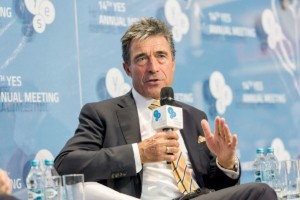 He’s good on international issues, but loses his credibility because he’s a paid agent of President Petro Poroshenko and an apologist for him.
Poroshenko also might want to question the value of whatever he’s paying Rasmussen. Introduced by Richard N. Haass as “the former everything,” Rasmussen suggested relaxing some economic sanctions against Russia in reward for good behavior. “If Russia accepts a robust mandate on a U.N. peacekeeping mission, like I said, for the whole Ukraine-Russia border and to protect the entire population, not only monitors, then, of course, a carrot for Russia could be a relief of some of the sanctions,” he said.
He obviously had not listened to Kurt Volker, the U.S. envoy, or Ukrainian Foreign Minister Pavlo Klimkin. Rasmussen generally had a poor idea of Ukraine’s position on the Russian-occupied territories: The sanctions must remain in place until the territorial integrity of Ukraine is completely restored, among other conditions including a cease-fire and withdrawal of Russian troops, weapons and financial support.
Gennady Burbulis
Secretary of State of RSFSR/Russian Federation (1991–1992); president of the Baltic-Black Sea Forum
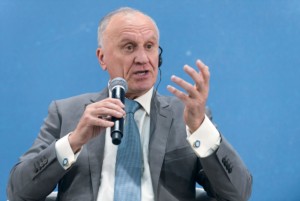 Once an influential political figure in 1980s and 1990s, Gennady Barbulis seemed an irrelevant speaker at the panel on Russia’s future. He demonstrated the Soviet art of talking long and saying little. He delivered a lengthy speech about the collapse of the Soviet Union and his work with the Boris Yeltsin administration. He seemed to deliberately use ostentatiously professorial and supercilious language that in reality made little sense. “Current situation in Russia demonstrates a deep birth trauma from imperialism common for the modern developed society. The future of Russia depends on the system of mythological construction,” and so on.
David Cameron
Prime Minister of the United Kingdom (2010–2016)
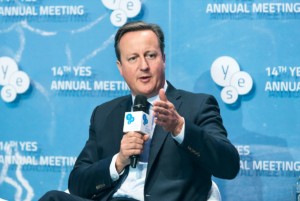 The former British prime minister, whose claim to historical fame will be losing a referendum that he called on whether the United Kingdom should leave the European Union, did a great job of blathering on. On a panel with ex-U.S. Secretary of State John Kerry, he appeared to forget his role in his country’s departure, saying: “I’m an avowed believer in global action.” He also threw a bone to divisive identity politics that embodied the pro-leave campaign in the Brexit referendum: “Democracy doesn’t mean giving up national identity.”