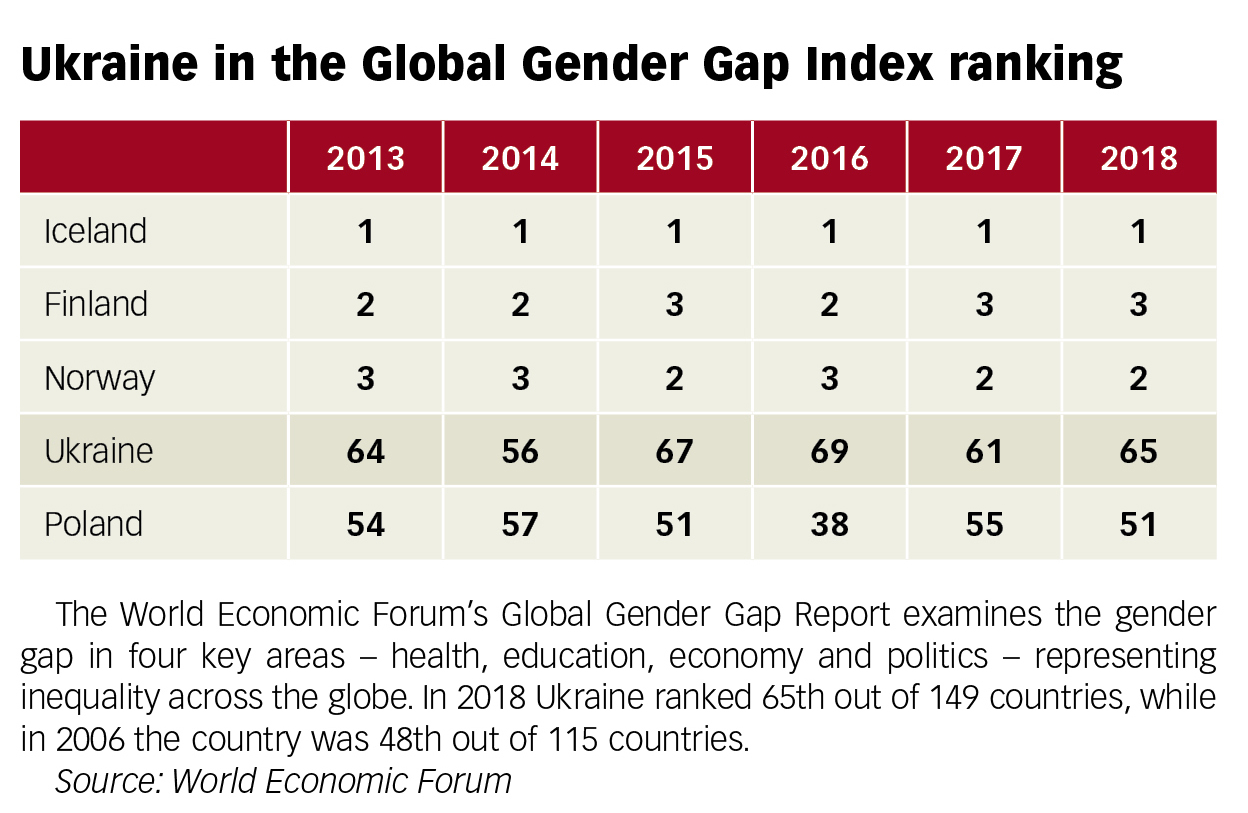
Gender inequality can cost a lot.
According to a 2015 study by U.S.-based McKinsey & Company, a worldwide management consulting firm, reducing gender inequality could add $12 trillion to the global economy by 2025. For Ukraine, the benefits would be enormous as well.
But achieving gender equality in Ukraine will require hard work and serious efforts to change traditional stereotypes about a woman’s role in society. Instead of just being seen as housewives, women can increasingly occupy high-level positions in such professional fields as science, information technology, engineering, architecture and entrepreneurship.
“Ukraine has very talented girls, but there are stereotypes and certain models (they have seen) since childhood. There are so many cases when a teacher in school says: ‘You’re a girl, you just need to get married successfully,” Elena Lopushenko, a product manager at German multinational software corporation SAP, told the Kyiv Post.
Often these stereotypes follow young women as they attend the university or continue their professional careers.
“Female (university) students said that their teachers, for example, would not give the highest score to a girl, even if she is the smartest,” said Maryna Saprykina, managing director at the Center for the Development of Corporate Social Responsibility in Ukraine.
However, international businesses in Ukraine are making some progress in numerous projects related to encouraging and supporting women in their professional lives.
Women in business
Just a month ago, Bank Lviv became the first bank in Ukraine to join the European Bank for Reconstruction and Development’s Women in Business initiative, which supports women entrepreneurs.
The EBRD is providing the bank with up to 4.3 million euros for low-interest lending to women who want to start their own businesses or develop existing ones. It is providing an additional one million euros in loans to support international and regional trade.
“This encourages women not to sit surrounded by four walls if they are housewives or if they work at some kind of production site, but to start something of their own,” said Anton Usov, EBRD’s senior adviser for external relations.
Besides loans with lower than average interest rates, the program has additional options such as special training for women on how do business and marketing, as well as advisory services on product placement.
Although no one has received any loans yet since the program started in late April, EBRD expects it to have positive results since similar programs proved successful in other countries, Usov said.
Usov also doesn’t see any risks for the program to fail.
“This (program) exists in different markets which have less favorable conditions than Ukraine. We work in Tajikistan and Kyrgyzstan, and, believe me, the markets there are much more complex,” he said.
According to Usov, the most popular businesses that receive support include services in cosmetology, hairdressing, cafes, restaurants, logistics, food processing, textiles and pharmacy.
“Our capacity to provide financial services tailored to the needs of women entrepreneurs and accompanied by consulting and mentorship support became so much stronger with the EBRD program,” said Lyudmila Mazurkevych, head of Bank Lviv’s marketing department.
The bank will provide loans from $3,700 to $344,500 for up to five years per person. The financing can be spent for any business purpose such as working capital, investments, real estate, renovation, expansion and marketing.
“It has to make business sense, and if it does, we will finance it,” said Mazurkevych.
Women in science
For those women who want to succeed in science, beauty products company L’Oréal in collaboration with UNESCO has been supporting women scientists in Ukraine throughout the last year.
“Ukraine was the last country in Eastern Europe where this program didn’t exist because of many political and economic crises in the country,” said Yulia Romanenko, communications director at
L’Oreal Ukraine.
Romanenko did not expect that many women would be interested in the program at the beginning.
“We thought it would be 50 applications… But we were happy when we received 255 applications from 30 cities all over Ukraine,” she said.
Out of these, 10 finalists were chosen by juries in collaboration with the National Academy of Sciences of Ukraine and the Center for CSR Development. After one final round of interviews, three winners were then selected – chemist Nataliia Shcherban, mathematician Olena Vanieieva, and biochemist Mariia Bailiak. Each winner received Hr 120,000, or $ 4,570, as a prize.
“Such programs stimulate and motivate people since it is very important to know that science is still needed in Ukraine. Young scientists often work only based on their enthusiasm, receiving a salary that is barely enough to live off. We need more such competitions so that scientists will stay in Ukraine,” Bailiak told the Kyiv Post.
“I haven’t used the prize yet. I’m planning to spend it, if necessary, on the implementation of my own ideas in science such as an internship at Åbo Akademi in Finland,” said Shcherban.
Besides its women in science program, L’Oreal launched another project in 2017 dedicated to helping women who are victims of domestic violence.
“These may be young mothers, orphan girls, and senior class students. With this program, women receive help to become professionals in the hairdressing business,” said Romanenko.
Women who are survivors of abuse or living in domestic violence shelters receive free vocational training as hairdressers for six months and are also provided with uniforms, as well as compensation for their travel expenses and food.
“Very often (victims of domestic violence) are left without means of subsistence, very often they have to live with their children in shelters. Our main goal is to help women not with food or money, but with more fundamental goals,” said Romanenko.
In total, 45 women have already completed these courses and received a profession.
STEM girls
Currently, there is a huge gap in Ukraine’s STEM (science, technology, engineering and mathematics) sector: 77 percent of STEM professionals are men, according to the Center for Development of CSR.
Three years ago, software firm SAP launched in Ukraine its special STEM project to support young women between the ages of 14 and 24 to develop in this sector. The company created a platform for communication between successful women and young girls.
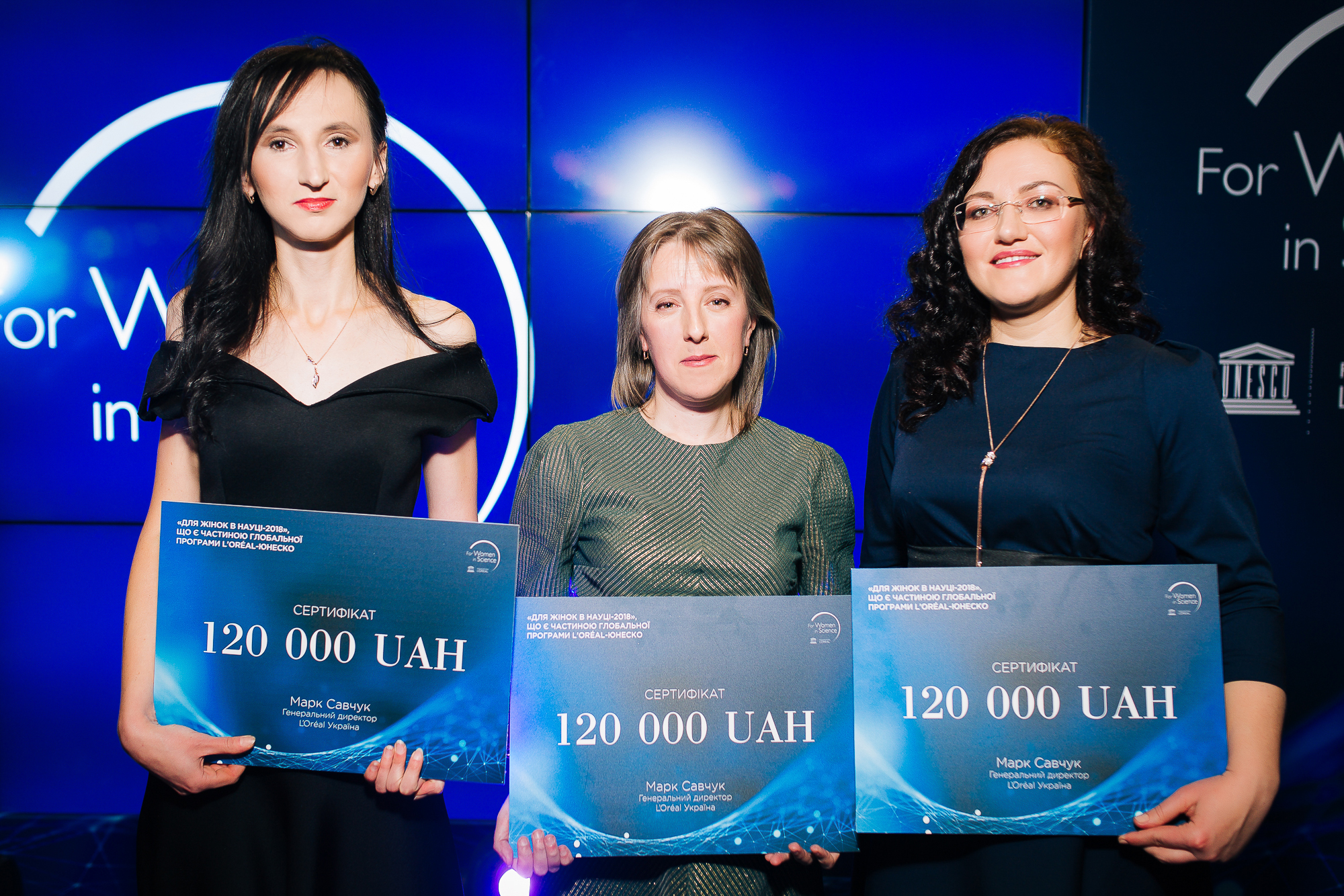
From left: Nataliia Shcherban, Mariia Bailiak and Olena Vanieieva were named winners of the joint L’Oréal-UNESCO For Women in Science program during an award ceremony in Kyiv on Nov. 30, 2018. (Courtesy)
“Each year, 20 successful women, who have already made a good career in the STEM fields, join the project and their task is to motivate girls (who want to do something similar),” said Lopushenko.
“When girls meet successful women, they see that these women also had some obstacles. They inspire and motivate girls to take a certain path and take some (concrete) steps,” she added.
In order to participate in this mentoring program, the teenage girls must submit a motivation presentation about what they want to learn from successful women and what projects they want to be involved in.
“In the final round, when all the projects are presented, a mentor woman chooses the project she likes the most and helps to implement it with resources, knowledge or networking,” said Lopushenko.
Among one of the most surprising projects for Lopushenko was a project called “Computer modeling: The reconstruction of abandoned buildings into creative platforms.”
The project was submitted by a 14-year-old girl, Anastasiya Kanivets, from the small town of Pomichna in Ukraine’s central Kirovograd Oblast.
Kanivets’ idea was to remake abandoned factories into modern art spaces that would include a cinema, art gallery, and a playground so that teens could have a place to hang out. In total, 24 girls became graduates of SAP’s program this year.
According to a national survey undertaken in Ukraine at the end of 2018, 81 percent of women and 73 percent of men said they believe that gender equality is an important issue. Now, Ukraine is tackling this issue in the workplace, but the road ahead is still long.