Igor Smelyansky, 42, gets regular criticism as the CEO of national postal operator Ukrposhta.
The state-owned behemoth employs 74,000 people and has been one of the slowest of the Soviet-legacy infrastructure companies to modernize. It is notorious for its slow delivery and often rough service.
Smelyansky prefers to see the complaints as useful signposts.
“I accept the criticism,” Smelyansky told the Kyiv Post during an interview held at a redesigned Ukrposhta branch in Kyiv on March 15. “It’s good that people castigate Ukrposhta and call it ineffective. If you don’t know about a problem, you simply can’t fix it.”
He says he knew what he was getting into when he took the job 18 months ago. Ukrposhta, established in 1994, was simply too cumbersome to be turned into a competitive business quickly.
Smelyansky’s ambition is to turn Ukrposhta into a top-notch postal service and courier company, perhaps even offering banking services.
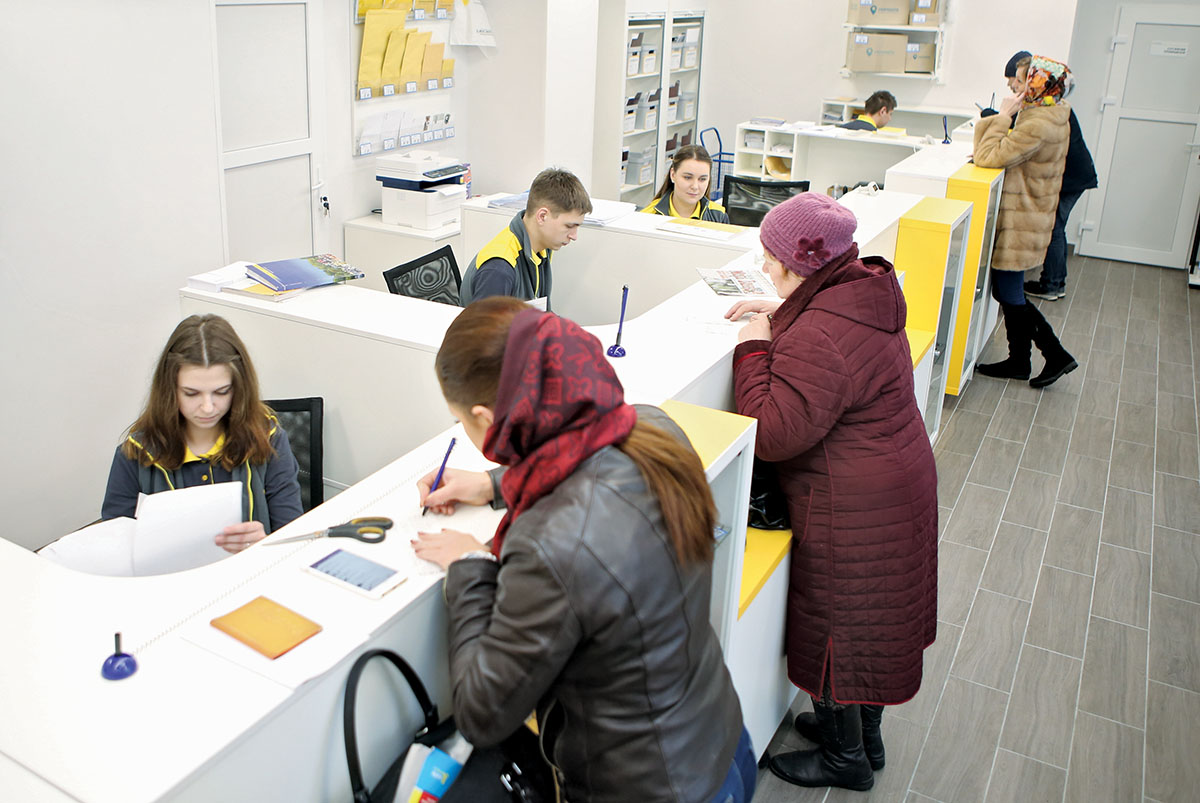
People send and receive deliveries at a redesigned national postal operator Ukrposhta branch in Kyiv on March 15. Ukrposhta has spent Hr 3 million to redo this branch, which is located at 106 Velyka Vasylkivska Street near Palats Ukraina subway station. The company promises to open at least eight more rebranded branches in Kyiv shortly. On the whole, Ukrposhta is going to launch 100 rebranded offices across Ukraine by the end of 2018. (Kostyantyn Chernichkin)
Former monopoly
Still sometimes seen as a monopoly, Ukrposhta has long lost its dominance to agile private delivery companies, such as Nova Poshta, Meest Express and Germany’s DHL. For example, Ukrposhta transports 22 million parcels a year, while Nova Poshta handles more than six times that number — 140 million.
“We have a monopoly only on common sense and social responsibility, as Ukrposhta has to provide services in remote villages where nobody else wants to work,” Smelyansky said.
Unlike private companies, Ukrposhta can’t close or move any of their 12,000 departments: The company is legally obliged to maintain all of their existing branches in order to continue servicing every area in Ukraine.
Ukrposhta can’t leave locations even if they are unprofitable. To prop up loss-making branches, the company receives a subsidy from the government to help cover the rent.
While this ensures every Ukrainian has access to communication services, “somebody has to pay for this,” Smelyansky said.
Giant private delivery service Nova Poshta doesn’t think that’s fair, however: It filed a claim against Ukrposhta in December, accusing it of illegal competition practices. In particular, Nova Poshta asks Ukraine’s Anti-Monopoly Committee to stop the government from subsidizing Ukrposhta by renting of the state and communal premises free of cost. According to the claim the private firm filed at the end of November, 57 percent of all Ukrposhta’s offices are rent for only Hr 1 a year.
Such benefits allow Ukrposhta to dump the prices, and thus “disfigure the competition” in Ukraine, the claim reads. “The governmental help provided to this enterprise is too generous.”
Smelyansky says the claim is groundless.
“Many postal services around the world are subsidized by governments to keep working in remote areas and maintain otherwise unprofitable premises,” he said. “Ukrposhta is forced to work in villages with populations of just 3,500 people.”
Apart from that, Ukrposhta can’t make cutbacks to its workforce of 74,000 employees.
“When I came, it was on the condition that I would be the first CEO who would not cut back on offices, and not fire employees,” he said. The condition was set out by the Cabinet of Ministers, which owned the company when Smelyansky was hired.
He compares his presence on the market with that of the private bank networks: There were 10,500 bank branches and close to 12,000 Ukrposhta post offices in 2016. The number of Ukrposhta offices now remains the same, while the number of bank branches has shrunk to 9,200.
With limited room for maneuver, and having to deal with the missteps of previous management, Ukrposhta has been overtaken by its more nimble private competitors.
“I’d like to be flexible and work like a private company, but we work according to different rules, and with different responsibilities,” he said.
Transforming Ukrposhta
Smelyansky, however, now has some of the flexibility he wanted. It came when Ukrposhta transformed into a public joint stock company with a single owner — the Infrastructure Ministry, under its current head, Volodymyr Omelyan.
Smelyansky says this has freed the company from excessive government control. He underscores three major changes: first, there is no longer any need to check minor decisions with ministries and institutions; second, the State Financial Inspection has no say in decision-making at Ukrposhta anymore; and third: “When officials or politicians demand that I do something or threaten to fire me, I remind them that they can no longer interfere,” Smelyansky said.

Ukraine’s Infrastructure Minister Volodymyr Omelyan sends a delivery using services at Ukrposhta’s rebranded branch in Kyiv on March 15. Ukrposhta has recently become a public joint stock company with a single owner – the Infrastructure Ministry, with Omelyan as its current head. (Kostyantyn Chernichkin)
Achievements as CEO
Ukraine pays Smelyansky Hr 330,000, or $12,500, a month. He says he has the results to justify his salary and his efforts.
Smelyansky claims that the company saw its revenues grow by an impressive 25 percent in 2017 — the highest rate in the last seven years, but this data couldn’t be verified since the company’s yearly financial report isn’t out yet. Previously, annual growth was around 5 percent.
“I’d like to double it,” Smelyansky said.
At the beginning of 2017 Ukrposhta has also adjusted to an increase in the minimum wage, raised from Hr 1,550 to Hr 3,200.
That translated into an increase in Ukrposhta’s payroll from Hr 2.7 billion ($108 million) in 2016 to Hr 4.1 billion ($164 million).
Ukrposhta’s revenues at that time were Hr 4.4 billion ($176 million), and “the company was so close to bankruptcy,” Smelyansky said. But the postal service not only survived this period, it has since invested in equipment, “buying more delivery cars over the past five months than the last five years.”
Smelyansky said he has managed to stamp out major corruption schemes in public procurement. He can’t take all the credit, however, as in summer 2016 all of the company’s procurement by law had to be done through ProZorro, an electronic public procurement system. Ukrposhta has saved Hr 400 million ($16 million) as a result.
But his main achievement, in Smelyansly’s view, is that in his 18 months in charge he has managed to change the company’s image. He has rebranded the company and rooted out Soviet approaches. “I want people to know that Ukrposhta isn’t an ineffective Soviet-era enterprise anymore,” he said.
E-commerce future
In 2017, the Ukrainian e-commerce market grew by 30 percent and was valued at approximately Hr 50 billion, according to tech management consultancy firm EVO. The firm estimates the market will grow to Hr 65 billion in 2018, and using as it does delivery services instead of bricks-and-mortar shops to get goods to customers, it’s a desirable market for Ukrposhta to tap into.
To do that, however, it’ll have to go head-to-head with Nova Poshta, the leading e-commerce delivery service provider, which has built up close links to e-businesses in Ukraine and abroad.
Smelyansky points to developed markets such as that of the United States, where several big delivery services all manage to take a slice of the delivery pie: “Ukrainian retailers are happy Ukrposhta is alive again,” Smelyansky said. “If a deliverer goes out of business, what will they do? Stop their operations? They need more than one or two options.”
According to Smelyansky, the presence of several players on the e-commerce delivery market will cut prices and improve service.
Ukrposhta is now partnering with Rozetka, Ukraine’s biggest internet store.
Smelyansky also wants to partner with foreign retailers, but Ukrposhta is currently limited to working only with other nations’ postal services — the law forbids it to take orders from online stores that deliver parcels through private delivery companies.
In order to work with private delivery companies, the government will have to amend the law, and Smelyansky says he is actively lobbying for the required changes. “Luckily, I’ll soon be able to work with all retailers, no matter what delivery company they use,” he said.
Ukrposhta as a bank
Ukrposhta has also hammered out a deal with Ukrainian billionaire oligarch Rinat Akhmetov’s First Ukrainian International Bank, known by its Ukrainian acronym PUMB, to provide loans in each of its post offices. The postal company sells PUMB loans through its network, and receives a fee on each operation.
Smelyansky calls it “banal money-making.” But there are more banking options for Ukrposhta.
Currently, the postal service pays out pensions in cash to 40 percent of Ukrainian pensioners, with the banks paying the other 60 percent cashlessly, using payment cards. Smelyansky would like to win a larger share of the pension payment business, but to operate cashlessly, the company will need a bank license.
Smelyansky is considering buying a small bank for this purpose, and says there’s more to it than just earning money. According to him, 15 million Ukrainians don’t have even a basic bank account. And “such a poor level of financial services” will only get worse, he says, as the number of banks decreases.
“Ukrposhta’s network is present in 100 percent of settlements,” he said.
“If Ukrposhta starts providing financial services, the ease of living in Ukraine will increase significantly.”
The Kyiv Post’s technology coverage is sponsored by Ciklum and NIX Solutions. The content is independent of the donors.