Kyiv’s Zhylianska Street is looking less and less like the bustling industrial center it used to be.
Over the course of several decades, its plants and factories have given way to office buildings and new housing, a transformation to a new business cluster and population center that is still under way.
Its new character is still taking shape.
One of the street’s newly-constructed high-rise buildings has recently become the Kyiv Post’s new headquarters. Mainly housing residential apartments, the 23-story building at 68 Zhylianska St. was developed by the KADORR Group, the construction giant owned by Adnan Kivan, the newspaper’s publisher.
What was there before? A two-story building that housed a shoe store.
The change is the latest turn in Zhylianska’s ongoing journey.
History of the street
The three-kilometer Zhylianska Street runs through three districts: Holosiivskyi, Pechersky and Shevchenkivsky. It starts in the capital’s center, close to Olimpiyska metro station, and ends near Vokzalna metro station.
The history of Zhylianska dates back to at least the first half of the 19th century.
Unlike with most other central streets, the origin of Zhylianska’s name is a mystery. There are several versions explaining how the street got its name.
It might have originated from the ancient pagan Slavic goddess of sadness Zheli. Or it could have evolved from the old Slavic term for a river bank, “zhal,” from “zhilka,” the name of a type of fish that used to dwell in the ancient Lybid River, or the small river Zhelan, mentioned in the 1093-1163 chronicles of Kyivan Rus.
In 1926, Zhylianska was renamed as Zhadanivskoho Street after Ukrainian soldier Borys Zhadanivsky, a participant of the 1905 Russian Revolution, which brought constitutional reform of the Russian Empire. It stayed like that until 1993, when Zhylianska regained its historical name two years into Ukraine’s independence as a nation.
Local residents and friends Oksana Anikina, 75, and Natalia Abramova, 69, have both lived on Zhylianska for more than 50 years. They reminisce that in the 20th century, when the street was called Zhadanivskoho, there was a big Jewish community living there. They also say that, back then, the street was better taken care of, compared to now.
“Then, the street used to be cleaned, new trees were planted, and the buildings weren’t (cramped) one upon the other,” they told the Kyiv Post.
The residents also have warm memories of a local outdoor cinema, which stood next to the Kyiv National Operetta Theater on the corner of Zhylianska and Velyka Vasylkivska streets. It has since been demolished.
“We loved coming there in summer and watching movies in the nightfall,” Abramova says.
Industrial Zhylianska
Back in the day, the street was home to many large enterprises: the first dairy factory in Kyiv, electrical engineering plant Transsignal, machine-building plant Leninska Kuznya, named after Vladimir Lenin, Gorky garment factory and others.
The 23 Zhylianska St. address used to be home of a famous chocolate factory Francois. It started as a confectionery workshop founded by Polish merchant Franz Golombek in 1874. At the beginning of the 20th century, Golombek also established a hotel on the street, called Furnished House Francois.
The former chocolate factory’s address now belongs to the State Tax Administration of the Holosiivskyi District.
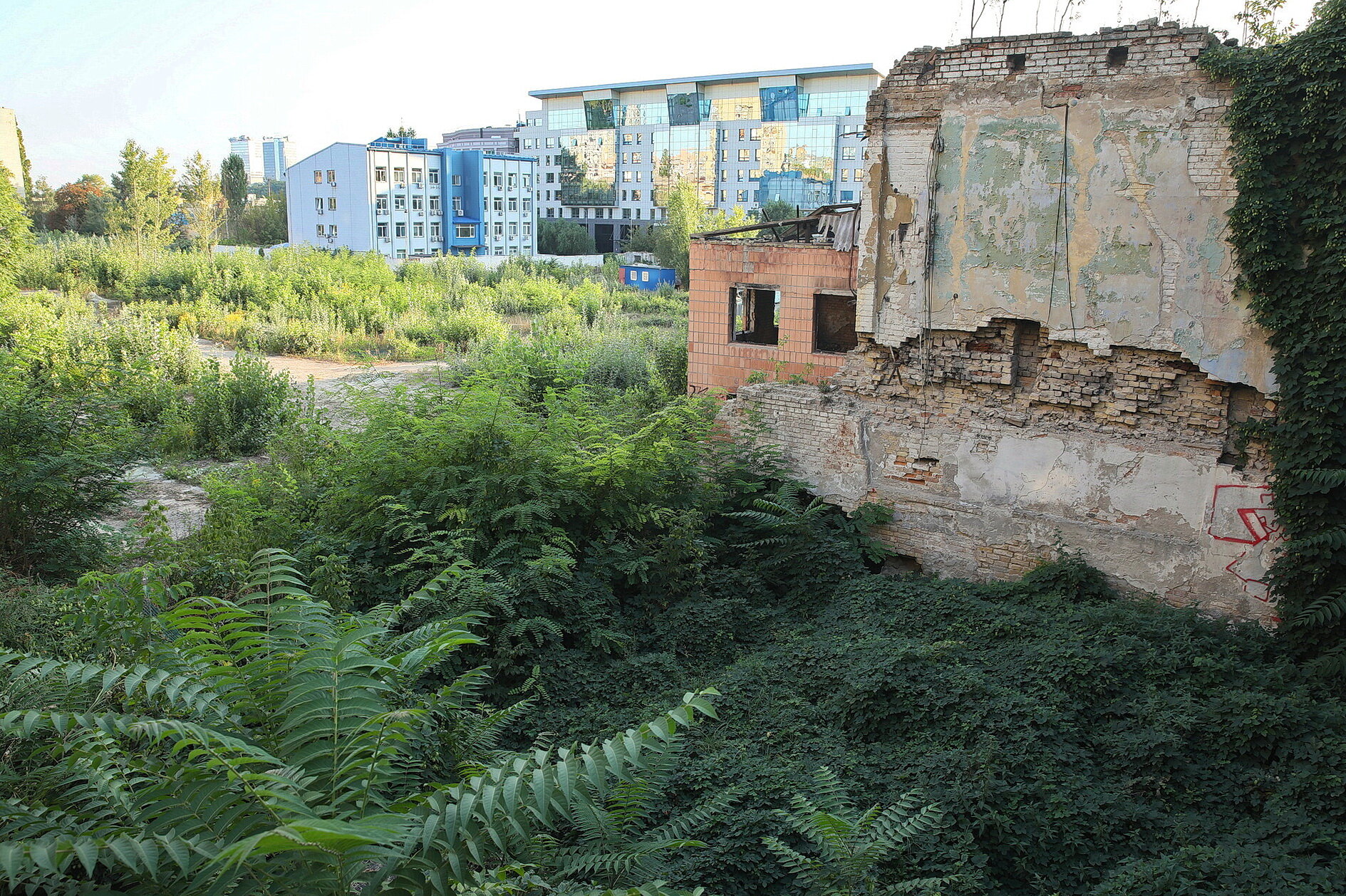
The plot at 47 Zhylianska St., where the Kyiv Dairy Plant operated until 2007, is the scene of a development dispute. While the owner is planning to construct a “multifunctional” high-rise comlex there, some locals demand that a park be created there. (Volodymyr Petrov)
Another prominent enterprise on Zhylianska Street was the Kyiv Dairy Plant. It opened in 1930 at what is now 47 Zhylianska St., across from the Kyiv Post office.
The plant operated for over seven decades, up until 2007. Locals still recall the tastiness of the sweet cottage cheese it produced. Through the years of Ukraine’s independence, the plant and its two-hectare land plot have been sold several times. Around 2007, the plant was demolished, and the precious land soon resold. At about the same time, the Kyiv City Council changed the land’s status from industrial to residential, allowing the new owners to develop apartment buildings on the plot.
According to a plan developed by the architectural bureau Kramall Studio in 2011, the then-owners planned to build a 21-story office and hotel complex there. That never happened.
The plot was resold in 2019 again, reportedly to a Ukrainian subsidiary of Turkish developer Metal Yapi Konut. According to the public registry, a Ukrainian company, Bluestone LLC, now owns the land. The company plans to develop a high-rise “multifunctional complex” there. The Kyiv Post couldn’t reach Bluestone LLC for comment.
However, many locals aren’t on board with the idea of a high-rise building appearing on the former plant’s land, which has been vacant for years. Some of them submitted a petition through the Kyiv City Council’s website, demanding the creation of a landscape park instead.
“Today the territory is a wasteland, and the fence around it is rather unappealing,” the petition reads.
The land plot is subject of at least two lawsuits. The developer sued the city for permission documentation to start construction – and won in early September. Meanwhile, a non-profit protecting Kyiv heritage is suing to stop the development.
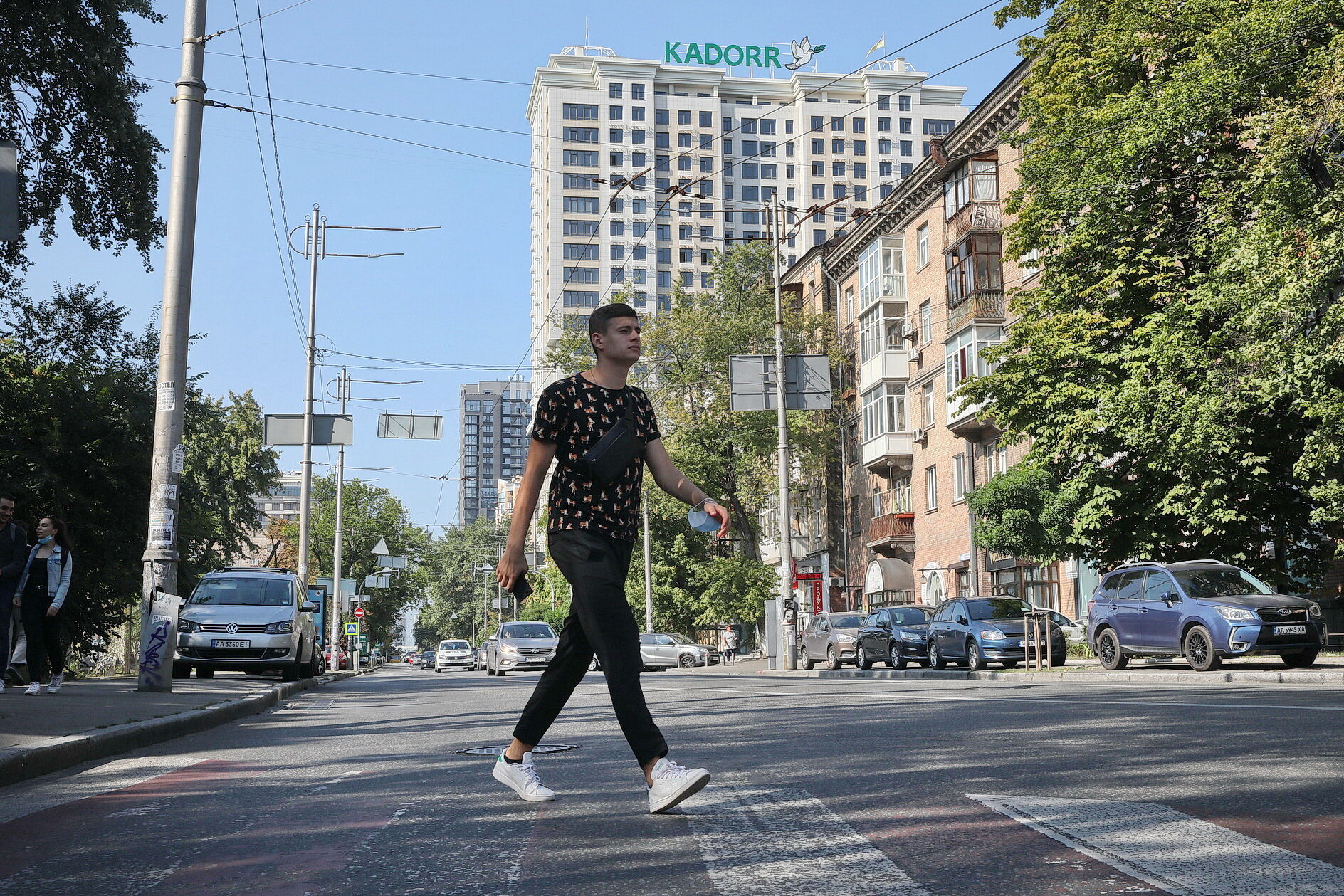
A man crosses Zhylianska Street, east of the KADORR Group building that houses the Kyiv Post, on Sept. 15, 2020 in Kyiv. The street’s history dates back to at least the first half of the 19th century, while the origin of its name remains unclear. Its character used to be industrial and there are still remnants of that era. It once housed a dairy plant, electrical engineering plant, machine-building plant, garment factory and chocolate factory. (Volodymyr Petrov)
Modern Zhylianska
Kyiv researcher and author of the book “Kyiv for Romantics,” Viktor Kirkevych, writes that everything about Zhylianska has changed over the years: its length, width, purpose, name and the social, ethnographic and political composition of the population.
Modern Zhylianska offers a contrasting view consisting of office towers and old brick apartment blocks.
It accommodates the Microsoft Ukraine office, the Eurasia and 101 Tower business centers, the office of British Council, the UK’s international organization for cultural and educational opportunities, and the office of Deloitte, an international audit and management consulting firm.
There are many restaurants, beauty salons, flower shops and stores. Among others, the street is home to Sam’s Steak House, Moloto Zeleno café and Chinese eatery Bruce Lee, as well as a popular premium-class gym, Smartass.
According to the General Plan of Kyiv, a document that offers strategic planning of city development, Zhylianska Street is considered “attractive for investment” and is expected to house more administrative, office and warehouse facilities in the future.
The development of the street is welcomed by local businesses. Sam’s Steak House, a restaurant that opened on 37 Zhylianska St. in 1995, has witnessed the changes since then.
“We’re happy that the street is being developed and becoming more lively,” Yana Seleznyova, a manager at Sam’s Steak House, told the Kyiv Post. We’re expecting more visitors, too.”