On the same day that Ukraine faced the biggest cyberattack in the nation’s history, two of the country’s senior intelligence officers were killed on June 27 in separate car bombings.
The officers, both veterans of Russia’s war on Ukraine in the Donbas, were assassinated less than 12 hours apart — one in Kyiv, and the other in a village near the city of Kostyantynivka in the country’s east.
The first killing occurred in Kyiv at 8:14 a. m., when a black Mercedes-Benz exploded at a crossroads near Solomyanska Street in the southeastern district of the city. The car’s driver, Maksym Shapoval, was killed instantly, while two passersby suffered minor injuries. The deadly blast was caused by a remotely triggered car bomb, Kyiv Police Chief Andriy Kryschenko said at the scene.
The incident was a terrorist attack, police spokesman Artem Shevchenko said. According to Interior Ministry adviser Zoryan Shkiryak, the car bomb had a yield equivalent to around one kilogram of TNT.
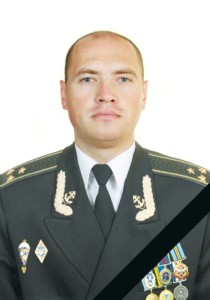
Maksym Shapoval
Special forces
The victim, Shapoval, was an active duty colonel in the Chief Directorate of Intelligence of Ukraine’s Ministry of Defense. Russian intelligence agents were quickly fingered as suspects by Ukrainian officials.
Shapoval, 39, had taken part in numerous combat operations in the Donbas. He commanded the first special forces unit to defend the Donetsk Airport in the initial stage of the battle there against Russian-backed forces in 2014, Ukraine’s chief military prosecutor, Anatoly Matios, said on June 27 after a meeting at the Presidential Administration.
“He was the first Ukrainian ‘cyborg,’” Matios said, using the popular nickname given to the defenders of the airport, which Russian-back forces overran in January 2015 and which now lies in ruins.
Shapoval was one of Ukraine’s best combat officers and an intelligence serviceman with “unique experience,” Matios said.
Exact details of his service were classified, he added.
But sources in Ukraine’s security services, who asked to remain anonymous because they were not authorized to speak publicly, told the Kyiv Post that Shapoval had commanded the 10th Special Forces Squad, carrying out operations behind enemy lines in the Donbas war zone.
At the time of his death, he headed the Special Reserve Forces Department at the Chief Military Intelligence Directorate in Kyiv. He was married with two children.
The assassination was carried out by top-rank specialists, Matios also said, with Russian agents as chief suspects.
Killing conspiracy
Just over 11 hours later, as the country was still in the grip of a massive cyberattack that hit banks, energy companies, the country’s main airport, the railway company, retail companies and postal services, a second deadly car bombing occurred.
Additionally, a car with three Security Service of Ukraine officers and a local civilian inside exploded at 7 p. m. local time while parked by the side of a road in the village of Illinivka near Kostyantynivka, a front-line Ukrainian-controlled city some 600 kilometers southeast of Kyiv.
One of the officers, later identified as SBU Colonel Yuriy Vozniy, was killed. The other three people were taken to hospital with serious injuries, Deputy Military Prosecutor Vitaliy Vdovichenko said on June 29.
He said that the surviving officers were not able to immediately provide information.
The SBU said 23 of the agencies officers have been killed on duty, but did not specify over which period of time.
As with the morning attack in Kyiv, military prosecutors in the war zone said the deadly blast near Kostyantynivka was a terrorist attack.
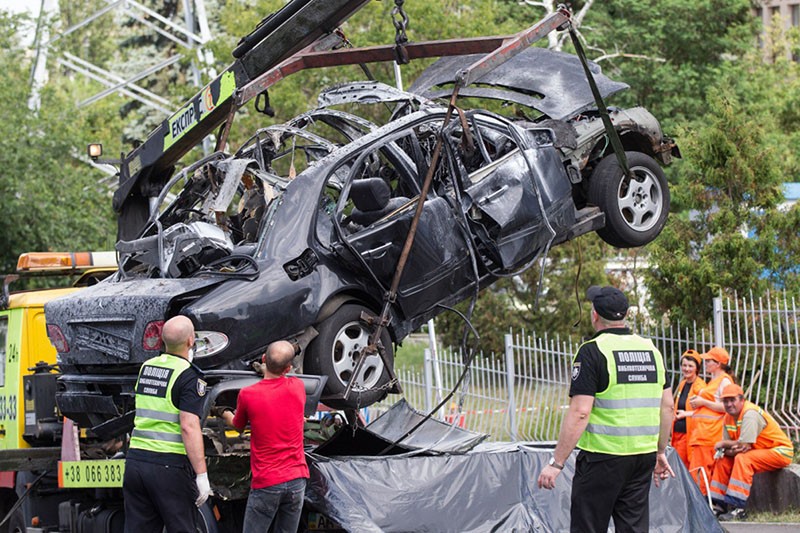
Ukrainian police tow a destroyed car away from the site of a car bomb attack in Kyiv on June 27. A senior Ukrainian military intelligence officer, Maksym Shapoval, was killed in the early-morning blast. (Ukrafoto)
Kremlin blamed
The June 27 blasts are just the latest in a growing number of attacks in recent months on senior Ukrainian servicemen behind the front lines, in government-controlled territory.
On March 31, another SBU counter-espionage colonel, Oleksandr Kharaberush, was killed by a car bomb as he was driving in a busy street in the city of Mariupol in Donetsk Oblast.
According to Ukrainian authorities, Russia is thought to have been behind a failed June 1 attack on Adam Osmaev, a Chechen fighter who fought in the Donbas war, and also the March 23 assassination on a street in central Kyiv of Vadim Voronenkov, a former Russian lawmaker who had defected to Kyiv.
The latest wave of car-bomb killings in Ukraine started with the murder of journalist Pavlo Sheremet in July 2016 in Kyiv — a crime as yet unsolved by law enforcers.
However, Ukraine’s top security officials say they have no doubt that the Kremlin is behind the increasingly frequent terror attacks throughout the country.
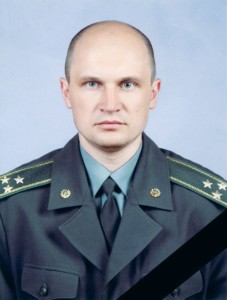
Yuriy Vozniy
Overstretch
Meanwhile, former Security Service of Ukraine Chief Valentyn Nalyvaichenko said the attacks showed more resources should be put into counterintelligence.
“They must complete an investigation into at least one of these murders,” ex-Security Service of Ukraine Chief Valentyn Nalyvaichenko said at a news briefing on June 29. “They must find out who made the explosive devices, where the devices came from and who the organizers are.”
Nalyvaichenko said that the patterns of recent car explosions targeting Ukrainian security officials were similar. He also said that less than 10 percent of the SBU’s employees were now involved in counterintelligence, and that was insufficient. Moreover, in 2015 a bill making counterintelligence and anti-terrorism the SBU’s top priorities was submitted to the president but it has not been adopted yet, Nalyvaichenko said.
At the same news briefing, Hennady Druzenko, the head of PDMSH, a volunteer group helping the military, said he thought the security services might be overstretched.
“I suspect that, when intelligence and law enforcement agencies are protecting the Presidential Administration and cracking down on Ukrainian businesses and volunteer fighters, they’re lacking resources to fulfill their main duty: defending the nation from Russian terrorist attacks in the center of our country,” Druzenko said.
Double strike
Over the past few months, Russia has been systematically escalating its subversive activities in Ukraine as a part of its hybrid war against Ukraine, National Security and Defense Council chairman Oleksandr Turchynov said on June 27.
“The weight of evidence suggests that all these murders were planned and organized with the direct involvement of the Russian special services,” Turchynov said during a council meeting following Shapoval’s killing.
“This terror attack is aimed at intimidating and destabilizing the country. It’s no coincidence that the (car bombing) took place amid a large-scale cyberattack, which had Russian origins as well.”
Interior Ministry spokesman Artem Shevchenko also claimed in a post on his Facebook page on June 27 that it was no coincidence that there were two high-profile assassinations and a massive cyberattack in the country on the same day.
The killing of Shapoval on June 27 was immediately followed by an “unprecedentedly large-scale cyberattack,” Shevchenko wrote, in the same way as the murder of the Russian defector Voronenkov on March 23 came on the same day as an alleged drone attack on a giant ammunition depot in Balakliya, which caused a massive fire and devastating explosions.
“It’s a double strike,” Shevchenko said.
Kyiv Post reporter Oleg Sukhov contributed to this report.