OLEKSIYIVKA, Crimea – Viktor Kuminov is bored. His son, Aleksei, sitting with his feet up on the desk in the snug control room of Pumping Station number 358, is even more bored.
These two engineers in the Pervomaisk region of northern Crimea are in charge of controlling pumps that are capable of shifting over a million tons of water per day. But the sluices are empty, and the pumps stand idle.
For more than two years, since Ukraine halted the water supply after Russia annexed Crimea in April 2014, father and son have been manning this station with nothing whatsoever to do but wait for the day when Ukraine turns the water back on.
“In principle everything’s in working order,” Viktor Kuminov said as he conducted an impromptu torchlit tour of the station’s many floors and looming silent machinery. “Just give us water, and we’ll get going again.”
The station is part of a gigantic engineering project which diverts water from the Dnipro river to Crimea’s parched steppe regions. One of the “great constructions of communism” ordered by Stalin in the 1950s and built largely by Comsomol (communist youth league) volunteers from all over the Soviet Union, it comprises the 402-kilometer Northern Crimean Canal running from Ukraine’s Kherson region to Crimea’s easternmost point at Kerch, seven reservoirs, and around 11,000 kilometres of side channels and pipes. Additional channels and pumping stations continued to be completed right into the 1990s; 80 percent of the water was used for agriculture.
Opened in 1984, station 385 is one of four such powerful stations in Crimea. It has its own electricity station, and used to pump water from the canal into the reservoir at Saki, about 50 kilometers away.
The central pump hall is still decorated with bright murals and banners proclaiming “Water to the Earth, Harvest to the People!” and “Labour glorifies Man!” In better times workers brought topsoil and planted trees and lawn grass around the buildings to create a small oasis here in the dry, windswept steppe.
Now, there’s no electric light for the lower floors, and no water even for the shower and toilet used by shifts of two or three workers still manning the station without much opportunity for glorifying labor.
“It’s not hard to keep it all going,” said Viktor’s son Aleksei, relaxing at a table in the control room and playing on his phone. “But another issue is that the budget’s been reduced.”
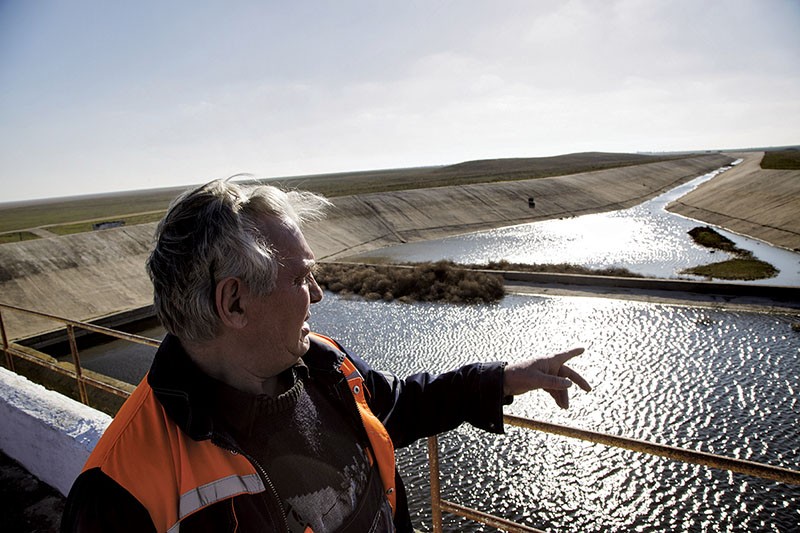
Viktor Kuminov, the hydro engineer who works at Northern Canal Pumping Station N358 points out to the rain water in the canal. The main source of water for the peninsula, the Northern Crimean Canal, was cut of from water supplies since 2014.
When Ukraine halted water supply, citing huge arrears from Crimea after Russia’s takeover, farmers panicked about fields already sown with water-dependent rice and vegetables. Viktor and Aleksei had another immediate concern: “They cut our wages,” said Viktor.
Viktor says he now gets up to 10,000 rubles ($150) a month, around half his previous salary. With 250 people working for the water system in his district alone, the costs must still be huge. “And they’re paying us all a salary for doing precisely what in practice?” he said.
Vladimir Mironyuk, head of the agriculture department of the Pervomaisk administration, confirms that the entire water regulation and distribution system is being preserved.
“The government takes this expense, because everyone understands that this water artery for Crimea is hugely significant,” he said. “If it’s thrown away today, it’ll take decades to replace.”
Other options floated by Crimean and Russian authorities, like bringing water from Russia’s southern Rostov region, would require building a new distribution system because the water, unlike Dnipro water, would run from east to north. “You’d have to change all the canals and pumping systems to work the other way,” said Vladimir Voytyuk, also from the Pervomaisk administration. “It’d be better to rebuilt from scratch, it’s all designed to work in one direction.”
Originally from the Urals in Russia, Viktor Kuminov has worked as a hydro-engineer in Crimea for 30 years. Water, or the lack of it, provides a living for his whole family: his wife and two sons work as engineers or administrators (his third son did too before being drafted into the Russian army).
He was resigned about his current situation, comparing it positively – as do many in Crimea – with the ongoing war in east Ukraine. “I can’t say if it’s sad or not, because do we have a choice? The main thing is there isn’t chaos here, like in Ukraine,” he said. “I have three sons and if we had such destruction in Crimea as there is in Ukraine, who knows what would happen to them?”
Meanwhile, as an agreement with Ukraine to re-open the canal and allow water again to flow remains a distant wish, there’s a nearer date he’s waiting for. “It’s four months until I can retire,” he said. n