Last year Interior Minister Arsen Avakov purchased a 26-room villa on the Mediterranean Sea coast in Italy worth more than $900,000.
Ukraine is one of the poorest countries in Europe with an average salary of $245 (or Hr 6,600.) But its rich and powerful prefer to live, study, seek medical treatment and spend holidays abroad.
Journalists of Nashi Hroshi investigative watchdog discovered that Avakov purchased the 566-square-meter villa, which includes a house and a pool, through the merger of his Italian registered company Avitalia S.R.L with another firm Ferdico S.R.L.
Ferdico S.R.L was the company, which received the ownership rights for the villa in Lazio province in February, the Italian state registry shows. Before the merger, the authorized capital of Ferdico S.R.L was just $36,646s.
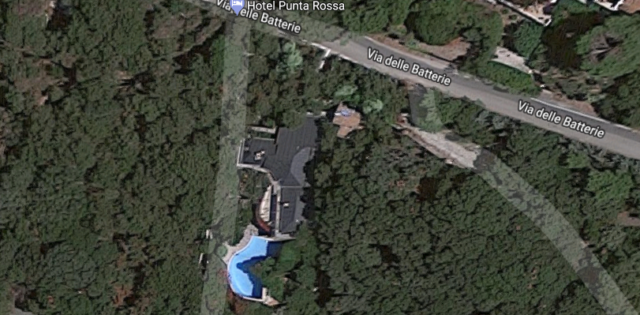
GoogleMaps photo of Arsen Avakov’s villa. (http://nashigroshi.org)
The journalists also found that before the merger Ferdico S.R.L, founded in 2013, had in its board Iryna Kuzhel, Nataliya Kozlova and Vadym Omelchenko — all three are the founders of Gorshenin Institute.
Gorshenin Institute is a Kyiv-based think tank which has founded Livy Bereh, a popular Ukrainian news website.
Avakov, however, said his villa is planned to be used for a tourist business of his wife Inna.
“It will be the building for a mini-hotel, purchased for the credit money with the use of assets of Avitalia company,” Avakov said in his comment shared with the Kyiv Post by Artem Shevchenko, the interior ministry’s spokesman.
“This is one of the tourist projects (my) wife is doing now. It’s legal, official and it has no sensations,” Avakov added.
Inna Avakova had a successful business year in 2017, managing to sell her 40 percent share in Espresso TV to a firm owned by Ivan Zhevago, son of Ukrainian oligarch and lawmaker Kostyantyn Zhevago for a 10-times profit.
Avakova and ex-Prime Minister Arsen Yatsenyuk bought their shares at a rate set in 2013 when Espresso TV was just in the making and sold them in 2017. Critics see signs of money laundering in the unusual transaction and profit in what is an unprofitable industry.
Avakova sold her share for Hr 55.8 million (or nearly $2 million). Avakov’s own income in 2017 was a bit more than $39,000, according to his tax declaration.