It’s a little country with big human rights problems that Western leaders are prone to ignore for the sake of oil.
Since 1993, the former Soviet republic of Azerbaijan, with 10 million people on the Caspian Sea, has been the fiefdom of the Aliyev family — first the father Heydar, the former Soviet KGB officer, and now the son, Ilham, who took over upon the father’s death in 2003.
It’s hard to say how popular Aliyev is because elections are not free or fair.
It’s hard to say how many people oppose Aliyev because critics are often thrown in jail or driven into exile.
And it’s hard to speak one’s mind — even insulting the president is against the law.
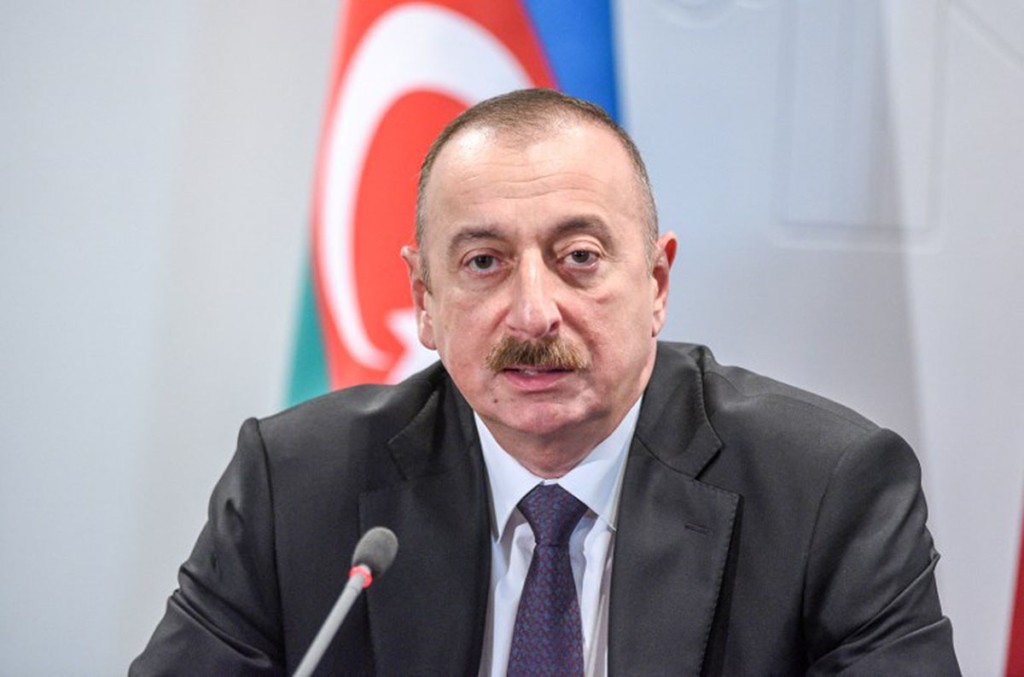
Azeri President Ilham Aliyev attends a press conference after a meeting with Latvian counterpart at the Riga castle, Latvia, on July 17, 2017. (AFP)
The cult of personality surrounding Heydar Aliyev — known as Heydarism — remains so extensive that airports, oil refineries, stadiums and buildings are named after him. Even streets and public squares in other nations carry his name, such as a square in Ukraine.
His son, Ilham, has ruled with an iron fist as well, kicking out foreign nongovernmental organizations, arresting dissenters and silencing journalists.
According to Amnesty International’s latest annual report, some political prisoners have been released but at least 14 remain in prison, including journalists, youth activists, politicians and religious activists.
A wave of crackdowns took place in the summer of 2014, including the arrests of human rights activists Leyla Yunus, Arif Yunus, Rasul Jafarov and Intiqam Aliyev.
Yunus was one of the most high profile critics of the Azerbaijani government. She was arrested a few days after calling for a boycott of the Baku European Games, but released in 2016.
Intiqam Aliyev and Jafarov were charged with tax evasion and illegal entrepreneurship. Rasul Jafarov started to be followed by Azerbaijani government in 2012, after organizing in the Sing for Democracy campaign during the Eurovision Song Contest hosted by Baku.
Aliyev pardoned some of the political prisoners, including Jafarov in 2016. However, Intigam Aliyev remains in prison.
Also, in May 2016, police arrested youth activists Giyas Ibrahimov and Bayram Mammadov for spraying graffiti on a monument to former President Heydar Aliyev. They were also charged with drug possession and sentenced to up to 10 years in jail
Jafarov told the Kyiv Post that the government crackdown aims to prevent political change and preserve vested economic interests.
“The Azerbaijani government tries to keep its power because of the economic interests. For this reason, they have aggression against youth activists, journalists and human rights defenders. The authorities consider them as enemies. If someone criticizes president, they decide to punish this person. Because, they are not tolerant. They show their power by punishing someone so no one can beat them.”
No free speech
Journalists, opposition newspapers and online websites have been pressured by the Azerbaijani government because of their work.
Freedom House classifies the media in Azerbaijan as “not free” and Reporters without Borders ranked the country 162 out of 180 countries in its annual World Press Freedom Index for 2017.
According to a report in Caucasian Knot, an online news site, 199 people remain political prisoners — including journalists, youth activists, politicians and religious activists.
On May 29, Azerbaijani investigative reporter Afghan Muktharli, 43, who had been living in exile in Georgia since 2015, disappeared from the streets of Georgia’s capital, Tbilisi, and reappeared two days later in a Baku prison.
Mukhtarli worked for several independent and opposition media outlets like Institute for War and Peace Reporting and Meydan TV. He investigated stories about corruption in Azerbaijan and business networks owned by the family of Azerbaijani President Ilham Aliyev and his business networks in Georgia.
In 2015, Azerbaijani journalist Rasim Aliyev was killed after criticizing footballer on his Facebook account.
In 2014, an Azerbaijani reporter Khadija Ismayilova was arrested for embezzlement and tax evasion. She had focused on corruption and offshore bank accounts linked to Aliyev. She was released in 2016.
In 2013, Ilgar Mammadov, the leader of REAL, an opposition group was arrested and sentenced to seven years in prison. He is still in prison.
Seymur Kazimov, an independent Azerbaijani journalist, says the government is not responsive to criticism from international human rights organizations. To the contrary, they attack journalists even more after such damning reports.
“If journalists are in prison, it cannot be hidden. We know it clearly that, under what kind of circumstances we are working in. At least, government can read international organizations’ reports and take into consideration them that, why international organizations are criticizing them,” Kazimov said. “Why are they arresting journalists?”
Jasur Mammadov Sumerinli, a journalist who worked as a military investigative reporter in Azerbaijan, moved to Germany in 2014 because of his investigations about the mysterious deaths of soldiers, corruption and bribery cases in the Azerbaijani army.
“In Azerbaijan, there are a few journalists who work independently, but government does not allow them to act freely. If we look at the Azerbaijani media today, we will see a group of people who are far from international journalistic rules. Those journalists are busy with fluttering the government, especially the president. Indeed, it is a very shameful situation.”
No opposition media
On May 12, critical news sites such as Radio Liberty, Meydan TV, Azadlig newspaper, The Azerbaijani Time and Turan TV channel were banned by a court ruling. The court claimed that these media outlets are threatening the country’s security.
Baku-based media expert Alasgar Mammadli told the KyivPost that blocking websites is part of curtailing free speech on the internet, yet people usually find ways around the prohibitions.
“The Azerbaijani government thinks that blocking opposition and independent websites is an alternative way. However, it is not true because, many people are using social networks such as Facebook, Twitter, and Instagram. It is impossible to block all ways without banning the whole internet system inside the country. If they block the network in Azerbaijan, they can prevent all of these.”
Speaking out
International organizations such as Amnesty International, Reporters Without Borders, Freedom House continue to call attention to human rights abuses and demand freedom for political prisoners.
For instance, on June 22, Reporters Without Borders called for the immediate release of at least 15 imprisoned bloggers, media workers and independent journalists who have recently been detained.
Jafarov, the human rights activist, said European countries such as France, Italy and Germany are not doing enough to pressure Aliyev on human rights. “These countries have enough power. However, they don’t do enough work on human rights issues in Azerbaijan,” Jafarov said.
In 2016, European Court of Human rights received 186 complaints concerning Azerbaijan, but 136 applications were declared inadmissible. n